
I’m Eating Frogs – And You Should Too
Hundreds of quotes have been attributed to Mark Twain, including this one:
“If it's your job to eat a frog, it's best to do it first thing in the morning. And If it's your job to eat two frogs, it's best to eat the biggest one first.”
Sound guidance, Mark. Thank you.
Here’s a Fantastic Time Management and Productivity Strategy for You

A Mark Twain mural in downtown Angels Camp, California
(This is an update of a popular blog article from 2021.)
Hundreds of quotes have been attributed to Mark Twain, including this one:
“If it's your job to eat a frog, it's best to do it first thing in the morning. And if it's your job to eat two frogs, it's best to eat the biggest one first.”
Sound guidance, Mark. Thank you.
With inspiration from Twain, the motivational author named Brian Tracy wrote a short book called Eat That Frog! 21 Great Ways to Stop Procrastinating and Get More Done in Less Time. The basic idea of his book is that all of us have “frogs” -- those things that we tend to procrastinate on -- and that it’s best to get these things off of our plate first thing in the morning. Once complete, you’ll get increased energy and momentum for the rest of the day. You’ve probably experienced this when you start the day with a clean desk, a sorted email inbox, or even a good workout.
Over the years I’ve really benefited from this strategy. My “frogs” tend to be operational things: writing proposals, refining our processes, reviewing the budget, etc. If I can knock those things out before the day gets rolling, then the rest of the day feels better and more productive.
It’s not always easy -- and I don’t follow-through 100% of the time -- but I definitely make much more significant progress on my “frogs” than what I would do otherwise.
That said, where this approach tends to fall down is that, in the end, it’s still a drag to eat a frog.
As Valerie Alexander writes in her article, Stop Eating Frogs! Just Be Happy, a key tip is to shift your mindset so that you see the frog in a new and much more positive light. If you can reframe the value of those things that you’re putting off, then your resistance to doing them will decrease.
To help me shift my mindset, I will sometimes ask myself:
What is the benefit of this for our team and customers?
What do we all lose if I don’t do it?
Those two questions have helped me positively reframe those things that I would otherwise put off.
In summary, I’ve found that the combination of these two strategies -- scheduling/taking action first thing in the morning and shifting my mindset -- have led to the best results.
Please share your comments below about your strategies for eating frogs.
Want a One-member Board?
The Best Size and Structure for Your Organization’s Governance

This is an updated version of one of Eric’s most popular blog articles.
How would you like it if your nonprofit had a one-member board?
If your board is difficult to manage and/or is not engaged, then a one-member board may sound dreamy.
What the Law Says
As it turns out, this isn't a fantasy. As amazing as it sounds, to legally incorporate in eighteen of the 50 states in the US, you only need one board member. One! And, in thirty other states you only need three board members to incorporate.
Now then, just because you can legally have such a tiny board doesn’t mean that it’s a good idea. In fact, it’s a very poor idea in nearly all situations.
But that begs the question… How large should your board be?
The Size of an Effective Group
Before we address that question let’s first assume that what you want is an effective and smooth-running group of people.
Social scientists have come up with research and formulas that argue that a group’s complexity and effetiveness is related to the number of interactions/relationships that can occur between the members of that group.
In the table below, you can see that as a group grows, the number of relationships and subgroups increases dramatically.
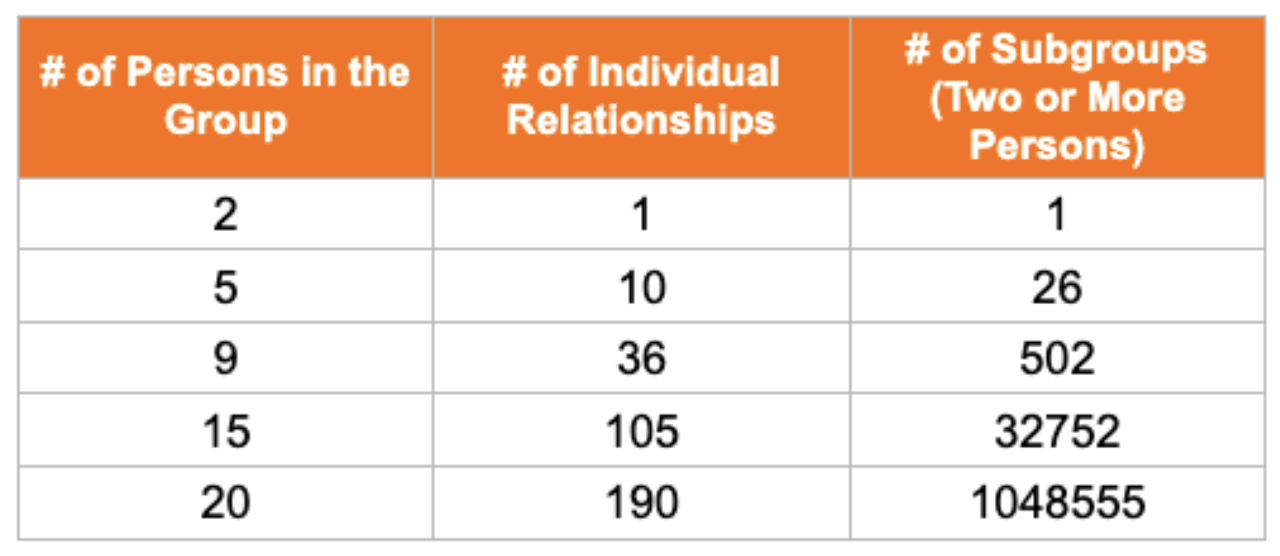
If you want to conduct your own calculations, “n” is the number in the first column:
# of Individual Relationships = n(n - 1) / 2 # of Subgroups = 2n - (n + 1)
Others have put forth simple “rules” like the “Rule of 7” – don’t make your team larger than seven – or the “Two-Pizza Rule” – if you can’t feed a team with two pizzas then the team is too large.
So, what’s the very simple take-away from all of this? Be very careful about growing the size of your board.
How Large Should Your Board Be?
Let’s get back to this original question, which I’ve been asked many times over the years.
As it turns out, there’s no one good answer and it varies wildly by organization.
The bylaws of some of our clients – especially associations and governmental agencies – specifically define the numbers of different constituencies that the board composition must reflect. So, unless you change your bylaws, this may mean that you have no choice but to have a board of twenty or more members.
If you’re required to have a large board then you’re faced with simply trying to make it as effective as possible. (A common solution is to create an effective committee structure that builds engagement and allocates responsibilities. Here is our blog article about this: “Five Tips for Running Successful Board Committees.”)
If your bylaws aren’t as prescriptive and, especially, if you run a small- or mid-sized organization, then my guidance is that your governance should have a two-part structure:
A board of directors of five to nine members, and
A complementary advisory council of up to fifteen persons
Regarding the board, five to nine members can:
Be nimble and respond rapidly.
Catalyze a stronger relationship between the executive director and board.
Simplify board communication and processes.
Have nearly 100% participation.
Lead to a much more coherent board culture.
While that may sound good, how can a board of this size effectively assist with all of those other things (fundraising, program support, marketing, legal guidance, etc.) that boards sometimes do?
Well, that's where a complementary advisory council comes in.
In the two-part structure – a board of directors and an advisory council – the board focuses on governance, budgeting, strategy, etc. while the advisory council simply serves as a loose group of stakeholders that can be called upon as needed.
The key phrase in that last sentence is “a loose group.” Since you probably already have your hands full with managing your existing board, the last thing that you want to do is create yet another group of people that have to be managed. With that in mind:
Think of your council as just a group of people that are happy to lend their names and some occasional time or talent to support your organization. They can be listed on your website and other documentation.
You call upon them, as needed.
Your council doesn’t have to meet or have rules and policies.
Be sure to call this group a “council” and not a board. “Council” typically connotes a more informal group than a “board.”
Keep it simple.
If you’d like to learn more about advisory councils then read our article, “A Fresh Approach for Your Nonprofit Advisory Council.”
Here are links to two organizations that have a two-part structure similar to this:
The Pablove Foundation (~ 9 board members and 15 advisors)
The Art of Elysium (~ 7 board members and 6 advisors)
Done well, this two-part structure allows you to get the best of both worlds: a fast-moving, happy, and easy-to-manage board and a strong set of supporting advisors.
Final Thoughts
If you’re considering adjusting the size of your board and/or advisory council, first consider the purpose for each of the groups:
What is the board’s purpose? Is it a working board? A governance board? Some combination? (Here is a foundational Boardsource graphic that lays out the core responsibilities of boards.)
For your advisory council, what is their purpose? Fundraising? Technical guidance? Legal advice? Community engagement? All of the above?
Getting clear on the purpose for these bodies will help you answer the question of how large the group should be.
Having an effective governance structure involves much more than just addressing the size and structure of your board. That said, structure strongly influences behavior so paying serious attention to the size and structure of your board can have a big impact.

How I Lost a $500 Bet
Many years ago a good friend of mine, Merrilee, and I were talking about some of our struggles to hit our personal and professional goals. We had no problem setting goals. We simply had problems hitting them.
Perhaps that sounds familiar to you.
Many years ago a good friend of mine, Merrilee, and I were talking about some of our struggles to hit our personal and professional goals. We had no problem setting goals. We simply had problems hitting them.
Perhaps that sounds familiar to you.
Well, during our conversation, we decided to create some real accountability to our goals. We created an experiment whereby we would have to pay the other person $500 if we didn't hit our monthly goals. And, on top of that, we would have to meet at a café and hand the $500 to the other person in twenty-dollar bills, one-by-one, just to feel the pain a little more.
It was quite an experience.
At the end of the very first month, Merrilee missed her goals. We met at a café, and she handed over the 25 $20 bills. I definitely felt a little weird about taking her money, but a deal was a deal and she clearly needed some accountability to her goals.
Merrilee never missed her goals for the rest of our experiment.
For me, I hit my goals month after month. The $500 deterrent — plus my basic competitiveness — was working for me.
Until the ninth month. I simply got careless and messed up, so off I went to the café where Merrilee happily took my $500. Or, depending on how you look at it, she took her $500 back.
We decided at that point to terminate the experiment. Even though it was successful in helping us hit our goals, neither one of us liked the negative accountability. Frankly, we simply wanted to hit our goals because we said we would, not because we'd lose $500.
Just like me, I bet that you’ve wondered how to best hit your goals. Thankfully, I’ve found many online tools that help me stay motivated and track progress. One app, Stickk, is something that I've successfully used. I’ve found Stickk’s combination of group accountability and reminders to be super helpful.
At Mission Met, Ricky (my business partner) and I use our software, Causey, to keep us on track with our team’s goals. We meet monthly and quarterly to review progress and take advantage of the email reminders that the software provides. Both the software and our mutual accountability help us hit our goals. It’s a great system.
What do you do to help you hit your goals? Or your team’s goals? Reply to this post and let us know.
How to Create Your Organization’s Core Values
Organizational values can be tricky to identify. You and your team likely value many things -- justice, quality, collaboration, innovation, etc. If you’re not careful, you’ll create a long list of values that sounds like the values of any organization.
That’s why we base our approach on the values identification model put forth in Pat Lencioni’s book, The Advantage.
Organizational values can be tricky to identify. You and your team likely value many things -- justice, quality, collaboration, innovation, etc. If you’re not careful, you’ll create a long list of values that sounds like the values of any organization.
That’s why we base our approach on the values identification model put forth in Pat Lencioni’s book, The Advantage. Lencioni’s model identifies four separate types of values:
Core – Only two-to-four inherent behavioral traits that are core and unique to your organization. It is hard to imagine compromising on these values.
Permission to Play – They are important to you, but most organizations like you would say the same thing. Integrity and honesty typically are “permission to play” values.
Aspirational – These things aren’t always true about your organization, but you want them to be. They don’t come naturally, so you have to work at them.
Accidental – Values that happen to us. They creep in but aren’t reflective of who you/want to be.

Your job is to identify your core values and not get distracted by the values in the other categories.
Here is a video from our strategic planning course, START, where I walk you through the model in more detail.
How to Create Your Core Values
Creating your core values is best done by a team and can take multiple conversations. We’ve come up with the following three-step process for your team to use.
Step 1: Begin With the End in Mind
Talk with your team about how you’ll use the values to guide your team’s behaviors and decisions. For example:
Discuss where your values will be posted (website, wall, etc.).
Determine when and how your team will discuss and review your values.
Share examples of how other organizations use their values.
Clarify how the values will be used in hiring and board recruitment.
Step 2: Brainstorm Some Values
Have your team brainstorm a list of possible values by answering these questions:
Think of those people in the organization that exemplify what is best about the organization. What are their core behaviors?
Think of those people that haven’t been a good fit for the organization. Think of their behaviors and then write down the opposite ones.
Step 3: Refine and Define
Review your list from Step 2 and group your responses in common categories. Identify one word or short phrase that best captures each category.
Review your categories and ask yourselves: Has this been a value of ours for a long time? Compared to other organizations that are like us, is this value somewhat unique?
Decide upon no more than four core values.
Create short descriptions of what the values mean to your organization.
Document the values on your organization’s strategic plan.
Note that your values may need to be revisited and refined over time, especially if your organization is new.
Example Core values
Below are some examples of values and their descriptions. Sometimes one word is used to describe a value and other times a short phrase is used. Either way works.
Transparency
We document and communicate our work to our team and key stakeholders.
Zeal
We value the passionate giving of our time and talents in whole-hearted service of others.
Make it Happen
We achieve ambitious goals without compromising our work/life balance.
Love Thy Neighbor
We strive to provide equal and respectful access to opportunities for our staff, volunteers, and those we serve.
I hope this process helps you and your team clarify and implement your core values. Be sure to share your comments and questions below.

Top 10 Quotes for Strengthening Your Organization
In my customer work I try to communicate powerful concepts in simple and memorable ways. One of my favorite tools to do this is using relevant and powerful quotes.
To that end I've collected scores of quotes during my career. Whittling that collection down to a "top 10" for this article was a tough exercise. Many excellent quotes didn't make the final list.
I ended up choosing this list because these are the quotes that I find most inspiring for myself and our customers. I hope you find them helpful.
In my customer work I try to communicate powerful concepts in simple and memorable ways. One of my favorite tools to do this is using relevant and powerful quotes.
To that end I've collected scores of quotes during my career. Whittling that collection down to a "top 10" for this article was a tough exercise. Many excellent quotes didn't make the final list.
I ended up choosing this list because these are the quotes that I find most inspiring for myself and our customers. I hope you find them helpful.
Quotes on Good Communication
"All problems exist in the absence of a good conversation." Chris Barrow
When I consider all of the problems our customers face in their organizations, nearly every single one could have been prevented with good communication. I love this quote and use it all of the time to reinforce the importance of stronger communication.
"Seek first to understand, then be understood." Stephen Covey
This phrase is the fifth habit of Covey's 7 Habits of Highly Successful People. If you're trying to strengthen the communication within your team or organization, consider using this line as a mantra. It’s gold.
Quotes on Planning
"Plans are worthless, but planning is everything." Dwight Eisenhower
Eisenhower’s quote is related to the battlefield where having an effective planning process literally means the difference between life or death. Even though planning at your organization may not have the same degree of urgency, the intent of this quote applies beautifully to nonprofit strategic planning. We wouldn’t say that your plan is “worthless”, but we definitely emphasize the critical importance of building a planning culture. (Here is a good article that shares other military quotes that relate to strategic planning.)
"Execution IS the Strategy." Laura Stack
Execution IS the Strategy is the title of Stack's 2014 book on creating a more effective organization. Similar to Eisenhower’s quote, above, this highlights the power of integrating execution into your planning process.
“There can be as much value in the blink of an eye as in months of rational analysis." From Blink by Malcolm Gladwell
In their search for the perfect plan, organizational leaders can spend months and months analyzing their organization. The crazy thing is, as Gladwell argues as a central theme of Blink, leaders can, instead, conduct a quick analysis that has as much accuracy as several months of navel gazing.
“Simplicity is the ultimate sophistication." Leonardo da Vinci
Years ago when I started to promote the value of simple and practical strategic plans, I had a concern that people would consider them "dumbed-down" versions of larger plans. Then I came across this quote and my intuitive sense of the power of simplicity was validated. (Steve Jobs once said this about simplicity: “Simple can be harder than complex: You have to work hard to get your thinking clean to make it simple. But it’s worth it in the end because once you get there, you can move mountains.”)
Quotes on Sales and Fundraising
"I have more fun and enjoy more financial success when I stop trying to get what I want and start helping others get what they want." From The One-minute Salesperson by Spencer Johnson, MD
I came across this quote over twenty years ago. At the time I viewed sales as a pushy and uncomfortable process. This quote helped me create an entirely new paradigm that sales and fundraising are, at their core, simply about serving others.
"Intention matters more than technique." Mahan Khalsa, Let's Get Real or Let's Not Play
This quote helps to solidify the prior quote. I always know that if my intention in the sales process is to serve -- even if my technique isn't perfect -- then everybody will be better off.
Organizational Culture and Teamwork
"Systems = Freedom" Gary Stauble
I attribute this quote to my good friend, Gary Stauble. (He said he heard it from a colleague several years ago.) The obvious irony in the quote is that people often think of systems as confining and limiting freedom. But I've found the opposite to be true. When you and your organization put the right systems in place to strengthen organizational efficiency, then you gain more freedom.
“Not finance. Not strategy. Not technology. It is teamwork that remains the ultimate competitive advantage, both because it is so powerful and so rare.” Pat Lencioni, The Five Dysfunctions of a Team
If you've read my other blog articles then you may know that I'm a huge fan of Lencioni and his work at The Table Group. I'll often pull this quote out about the tremendous leverage provided by strong teamwork.
I hope these quotes resonate for you. If you have a quote that has inspired you and your work, please share it below.
Tips on Eating Frogs
Hundreds of quotes have been attributed to Mark Twain, including this one:
“If it's your job to eat a frog, it's best to do it first thing in the morning. And If it's your job to eat two frogs, it's best to eat the biggest one first.”
Sound guidance, Mark. Thank you.
A Mark Twain mural in downtown Angels Camp, California
Hundreds of quotes have been attributed to Mark Twain, including this one:
“If it's your job to eat a frog, it's best to do it first thing in the morning. And If it's your job to eat two frogs, it's best to eat the biggest one first.”
Sound guidance, Mark. Thank you.
With inspiration from Twain, prominent motivational author Brian Tracy wrote a short book called Eat That Frog! 21 Great Ways to Stop Procrastinating and Get More Done in Less Time. A basic idea of his book is that all of us have “frogs” -- those things that we tend to procrastinate on -- and that we’re best off by getting these things off of our plate first thing in the morning. Once complete, you’ll get increased energy and momentum for the rest of the day. You’ve probably experienced this when you start the day with a clean desk, a sorted email inbox, or a good workout.
Over the years I’ve benefited from this strategy. My “frogs” tend to be operational things: writing proposals, updating our CRM, reviewing the budget, etc. If I can knock those things out before the day gets rolling, then the rest of the day feels better and more productive.
I love the mornings and have always gotten up early ever since I was a paperboy in San Diego as a teenager. I currently have a block on my calendar from 5:00-6:30 AM where I address some of those operational things. I also have a spreadsheet where I track my progress and then discuss those things with my team. This combination of structure and accountability really helps me get things done that I’m not as likely to do otherwise.
It’s not always easy -- and I don’t follow-through 100% of the time -- but I definitely make much more significant progress on my “frogs” then what I would do otherwise.
That said, where this approach tends to fall down is that, in the end, it’s still a drag to eat a frog.
As Valerie Alexander writes in her article, Stop Eating Frogs! Just Be Happy, a key tip is to shift your mindset so that you see the frog in a new and much more positive light. If you can reframe the value of those things that you’re putting off, then your resistance to doing them will decrease. That’s great advice.
To help me shift my mindset, I will sometimes ask myself:
What is the benefit of this for our team and customers?
What do we all lose if I don’t do it?
Those two questions have helped me positively reframe those things that I would otherwise put off.
In summary, I’ve found that the combination of these two strategies -- scheduling/taking action first thing in the morning and shifting my mindset -- have led to the most satisfying results.
Please share your comments below about your strategies for eating frogs.
A Simple Research-based Tip for Setting More Effective Goals
For several years we’ve told our clients that there are two types of goals: process goals and results goals. For example, a process goal may be "to write one grant per month." The correlating results goal might be "to acquire $100K in new funding this year."
So, for these goals, the question is: "Which goal will help us get the result we want -- the $100K?" The correct answer is "it depends.”
For several years we’ve told our clients that there are two types of goals: process goals and results goals. For example, a process goal may be "to write one grant per month." The correlating results goal might be "to acquire $100K in new funding this year."
So, for these goals, the question is: "Which goal will help us get the result we want -- the $100K?" The correct answer is "it depends.”
However, research highlighted by Chip and Dan Heath in their book, Switch, indicates that process goals (the research calls them behavioral goals) may have nearly three times the effectiveness of results goals in helping you get what you want! Here's what the Heaths say on page 62 of their book:
In a pioneering study of organizational change, described in the book The Critical Path to Corporate Renewal, researchers divided the change efforts they'd studied into three groups: the most successful (the top third), the average (the middle third), and the least successful (the bottom third). They found that, across the spectrum, almost everyone set goals: 89 percent of the top third and 86 percent of the bottom third. A typical goal might be to improve inventory turns by 50 percent. But the more successful change transformations were more likely to set behavioral goals: 89 percent of the top third versus only 33 percent of the bottom third. For instance, a behavioral goal might be that project teams would meet once a week and each team would include at least one representative of every functional area. Until you can ladder your way down from a change idea to a specific behavior, you’re not ready to lead a switch. For you visual learners, I've captured the main finding of their research in the graphic below:

What's the main tip for you? Well, the next time you and your team are setting goals, be sure to consider incorporating process goals. You may end up getting better results!
Research Indicates a Strong Positive Correlation Between Strategic Planning and the Fundraising Success of Small Nonprofits
In 2020, Mission Met set out to learn more about the relationship between strategic planning and fundraising. For years, I've seen the positive effect that strategic planning has on the ability to fundraise successfully, but I've never had qualitative data to back it up.

For years, I've seen the positive effect that strategic planning has on the ability to fundraise successfully, but I've never had quantitative data to back it up.
With that in mind, in 2020 we conducted a survey to learn more about the relationship between strategic planning and fundraising. We distributed a brief survey through our networks and gathered 169 responses from leaders of small nonprofits from six continents. From our research, we made two key conclusions:
1. Having a Strategic Plan Significantly Increases Fundraising Success
86% of respondents said that having a strategic plan had a positive impact on generating revenue (grants, appealing to donors, earned income, events, etc.).
Further, respondents said that, on average, between 36% and 45% of their nonprofit’s annual revenue can be attributed to the presence of a strategic plan.
2. Regularly Tracking a Strategic Plan Strongly Correlates with Generating Revenue
As indicated in the chart above, respondents that regularly reviewed, revised, and measured their strategic plan were over six times (58% vs. 9%) more likely to say that their strategic plan helps their nonprofit generate revenue.
Learn More
If you’re interested in reading our full analysis with accompanying tables and graphs, provide us with your email and we will send you the report.
Death by Meeting
I've borrowed the title for this blog entry from one of my favorite business books, Death by Meeting by Pat Lencioni. The basic idea of the book is not that you'll die by meetings. Rather, you might die from awful meetings.
As you know, awful meetings happen all the time. They take too long. They wander aimlessly. They don’t start or end on time. You’d pretty much rather be anywhere else.

I've borrowed the title for this blog entry from one of my favorite business books, Death by Meeting by Pat Lencioni. The basic idea of the book is not that you'll die by meetings. Rather, you might die from awful meetings.
As you know, awful meetings happen all the time. They take too long. They wander aimlessly. They don’t start or end on time. You’d pretty much rather be anywhere else.
Well, it doesn't have to be that way. I know because we’ve lead hundreds of successful meetings each year, both in-person and virtually. In fact, we just facilitated a 4-hour Zoom meeting yesterday (yes, a four-hour Zoom meeting) that began on time, ended on time, led to a clear set of action items, and left all thirteen people in attendance raving about what a great use of time it was. Imagine people leaving a four-hour virtual meeting actually happy to have been in attendance!
Although we have many tricks to running effective meetings, there is a foundational tip that stands above all the rest: Communicate your meeting outcomes at the outset.
I know, this may not seem like much. But I promise you that it’s a game-changer.
You see, most people create meeting agendas that say we’re going to talk about this, discuss that, etc. As a result, the meeting just ends up being a bunch of talking.
In contrast, what we do is establish and communicate a set of specific meeting outcomes for what we will accomplish by the end of the meeting. We transform a typical meeting agenda item to a specific meeting outcome. For example…
Social media discussion ➡ Review and document revisions to our LinkedIn strategy
Discuss organizational values ➡ Each meeting participant will have provided a specific example of how we are living an organizational value
Review our strategic plan ➡ Progress on each of the goals in our strategic plan will have been measured and documented
Notice that each of the outcomes are much more specific when compared to the corresponding agenda item. And, with that specificity comes a significantly more focused conversation that saves time and increases relevance. It's amazing to watch my clients' meetings become more powerful and efficient when they simply employ this tip.
So, when you're preparing for your next meeting, ask yourself this question: "What, specifically, do we want to accomplish by the end of the meeting?" Then, document your responses as outcomes on your agenda, review them with your meeting participants at the beginning of the meeting, and drive the conversation toward those outcomes. Simple and powerful.
Of course, there are lots of other tips to strengthen meetings. But without a set of clearly defined outcomes, all of the other tips lose power.
Here are some resources to help you run more effective meetings:
A sample meeting agenda that highlights outcomes
Death by Meeting by Pat Lencioni
Richard Lent's website and his book, Meeting for Results Tool Kit. Richard is a consultant that specializes in running effective meetings.
How are your organization’s meetings run?
A Coronavirus Walks Into a Bar...
If you’re like me, humor has lifted my spirits recently. I’ve laughed at some COVID-related jokes and memes people have shared with me. I’ve really enjoyed the videos of our pets wishing that we’d go back to work so they can have the house to themselves again. Thank you to those that have lifted my spirits.

If you’re like me, humor has lifted my spirits recently. I’ve laughed at some COVID-related jokes and memes people have shared with me. I’ve really enjoyed the videos of our pets wishing that we’d go back to work so they can have the house to themselves again. Thank you to those that have lifted my spirits.
But it’s tricky. I’ve also been hurting for people everywhere whose lives have been turned upside-down. When so many are suffering, is it OK to smile or take joy in a joke related to the cause of so much pain?
As a leader, and you are a leader, using humor in the right way and time can positively influence others. But it can also seem callous, insensitive and out of touch for those in pain or unable to receive it. You have to make that judgment.
Humor -- bringing it and responding to it -- is one of our personal freedoms. Several years ago I read a classic book on our ability to choose how we respond in the face of a dire situation. Viktor E. Frankl’s Man’s Search for Meaning is about the real experience of navigating and surviving the unimaginable horrors of a Nazi concentration camp. Frankl writes:
We who lived in the concentration camps can remember the men who walked through the huts comforting others, giving away their last piece of bread. They may have been few in number, but they offer sufficient proof that everything can be taken from a man but one thing: the last of the human freedoms -- to choose one's attitude in any given set of circumstances, to choose one's own way.
With that in mind, appropriately choosing to bring lightness to our situation -- such as with humor -- can help all of us get through.
With that in mind, consider sharing this joke with your friends. It’ll likely get both a smile and a groan:
A Coronavirus walks into a bar.
The bartender says, “Sorry, we don’t serve viruses here!”
The coronavirus replies, “Well, you’re not a very good host!”