
Want a One-member Board?
The Best Size and Structure for Your Organization’s Governance

This is an updated version of one of Eric’s most popular blog articles.
How would you like it if your nonprofit had a one-member board?
If your board is difficult to manage and/or is not engaged, then a one-member board may sound dreamy.
What the Law Says
As it turns out, this isn't a fantasy. As amazing as it sounds, to legally incorporate in eighteen of the 50 states in the US, you only need one board member. One! And, in thirty other states you only need three board members to incorporate.
Now then, just because you can legally have such a tiny board doesn’t mean that it’s a good idea. In fact, it’s a very poor idea in nearly all situations.
But that begs the question… How large should your board be?
The Size of an Effective Group
Before we address that question let’s first assume that what you want is an effective and smooth-running group of people.
Social scientists have come up with research and formulas that argue that a group’s complexity and effetiveness is related to the number of interactions/relationships that can occur between the members of that group.
In the table below, you can see that as a group grows, the number of relationships and subgroups increases dramatically.
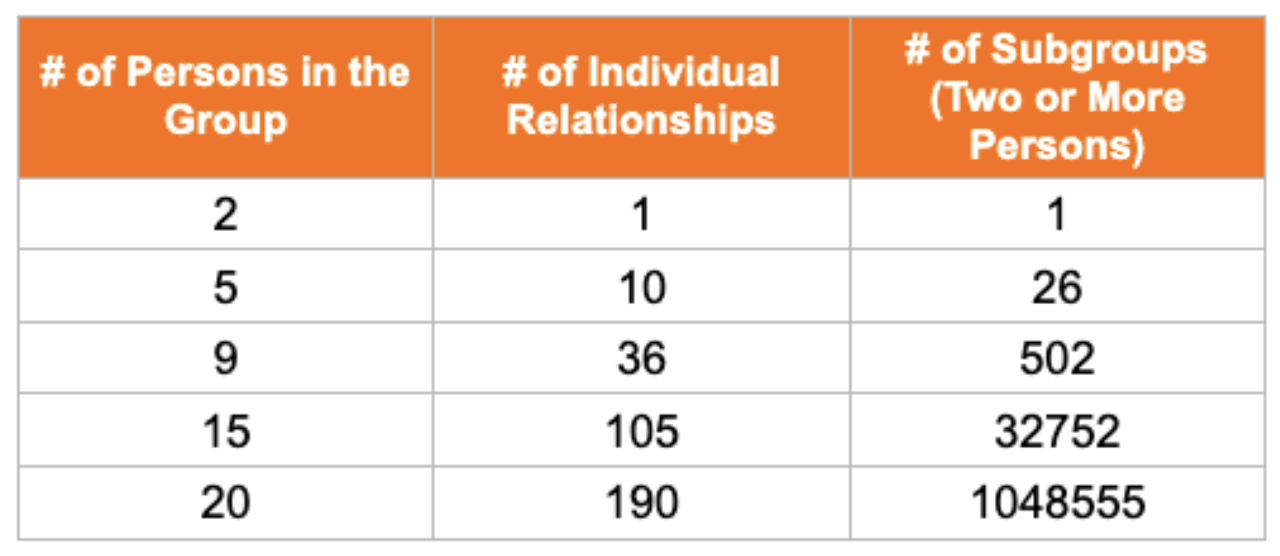
If you want to conduct your own calculations, “n” is the number in the first column:
# of Individual Relationships = n(n - 1) / 2 # of Subgroups = 2n - (n + 1)
Others have put forth simple “rules” like the “Rule of 7” – don’t make your team larger than seven – or the “Two-Pizza Rule” – if you can’t feed a team with two pizzas then the team is too large.
So, what’s the very simple take-away from all of this? Be very careful about growing the size of your board.
How Large Should Your Board Be?
Let’s get back to this original question, which I’ve been asked many times over the years.
As it turns out, there’s no one good answer and it varies wildly by organization.
The bylaws of some of our clients – especially associations and governmental agencies – specifically define the numbers of different constituencies that the board composition must reflect. So, unless you change your bylaws, this may mean that you have no choice but to have a board of twenty or more members.
If you’re required to have a large board then you’re faced with simply trying to make it as effective as possible. (A common solution is to create an effective committee structure that builds engagement and allocates responsibilities. Here is our blog article about this: “Five Tips for Running Successful Board Committees.”)
If your bylaws aren’t as prescriptive and, especially, if you run a small- or mid-sized organization, then my guidance is that your governance should have a two-part structure:
A board of directors of five to nine members, and
A complementary advisory council of up to fifteen persons
Regarding the board, five to nine members can:
Be nimble and respond rapidly.
Catalyze a stronger relationship between the executive director and board.
Simplify board communication and processes.
Have nearly 100% participation.
Lead to a much more coherent board culture.
While that may sound good, how can a board of this size effectively assist with all of those other things (fundraising, program support, marketing, legal guidance, etc.) that boards sometimes do?
Well, that's where a complementary advisory council comes in.
In the two-part structure – a board of directors and an advisory council – the board focuses on governance, budgeting, strategy, etc. while the advisory council simply serves as a loose group of stakeholders that can be called upon as needed.
The key phrase in that last sentence is “a loose group.” Since you probably already have your hands full with managing your existing board, the last thing that you want to do is create yet another group of people that have to be managed. With that in mind:
Think of your council as just a group of people that are happy to lend their names and some occasional time or talent to support your organization. They can be listed on your website and other documentation.
You call upon them, as needed.
Your council doesn’t have to meet or have rules and policies.
Be sure to call this group a “council” and not a board. “Council” typically connotes a more informal group than a “board.”
Keep it simple.
If you’d like to learn more about advisory councils then read our article, “A Fresh Approach for Your Nonprofit Advisory Council.”
Here are links to two organizations that have a two-part structure similar to this:
The Pablove Foundation (~ 9 board members and 15 advisors)
The Art of Elysium (~ 7 board members and 6 advisors)
Done well, this two-part structure allows you to get the best of both worlds: a fast-moving, happy, and easy-to-manage board and a strong set of supporting advisors.
Final Thoughts
If you’re considering adjusting the size of your board and/or advisory council, first consider the purpose for each of the groups:
What is the board’s purpose? Is it a working board? A governance board? Some combination? (Here is a foundational Boardsource graphic that lays out the core responsibilities of boards.)
For your advisory council, what is their purpose? Fundraising? Technical guidance? Legal advice? Community engagement? All of the above?
Getting clear on the purpose for these bodies will help you answer the question of how large the group should be.
Having an effective governance structure involves much more than just addressing the size and structure of your board. That said, structure strongly influences behavior so paying serious attention to the size and structure of your board can have a big impact.