
Death by Meeting
(This is an updated version of one of our most-read blogs from several years ago. It’s about a timeless topic: running effective meetings.)

I've borrowed the title for this blog entry from one of my favorite business books, Death by Meeting by Pat Lencioni.
The basic idea of the book is not that you'll die by meetings. Rather, you might die from awful meetings.
As you know, awful meetings happen all the time. They take too long. They wander aimlessly. They don’t start or end on time. You’d pretty much rather be anywhere else.
It doesn't have to be that way. I lead hundreds of successful meetings each year, both in-person and virtually. In fact, I recently facilitated a four-hour Zoom meeting (yes, a four-hour Zoom meeting) that began on time, ended on time, led to a clear set of action-items, and left all thirteen people in attendance raving about what a great use of time it was. Imagine people leaving a four-hour meeting actually happy to have been in attendance!
Although I have many tricks to running effective meetings, there is a foundational tip that stands above all the rest: Communicate your meeting outcomes at the outset.
You see, most people create meeting agendas that say we’re going to talk about this, discuss that, etc. As a result, the meeting just ends up being a bunch of talking.
In contrast, what I try to do for most of my meetings is establish and communicate a set of specific meeting outcomes for what we will accomplish by the end of the meeting.
I know, this may not seem like much. I get it. But I promise you that this simple technique is a game changer for your meeting effectiveness.
To give a sense of what this looks like, below I’ve provided some comparisons between agenda items versus meeting outcomes.
Agenda Item: Social media discussion vs. Meeting Outcome: Document revisions to our LinkedIn strategy
Agenda Item: Discuss organizational values vs. Meeting Outcome: Each meeting participant will have provided a specific example of how we are living an organizational value
Agenda Item: Review our strategic plan vs. Meeting Outcome: Progress on each of the goals in our strategic plan will have been measured and documented
Notice that each of the outcomes are much more specific when compared to the corresponding agenda item. And, with that specificity comes a significantly more focused conversation that saves time and increases relevance. It's amazing to watch my clients' meetings become more powerful and efficient when they simply employ this tip.
Here is a sample meeting agenda that provides some more examples of how outcomes can be worded.
So, when you're preparing for your next meeting, ask yourself this question: "What, specifically, do we want to accomplish by the end of the meeting?" Then, document your responses as outcomes on your agenda, review them with your meeting participants at the beginning of the meeting, and drive the conversation toward those outcomes. Simple and powerful.
Of course, there are lots of other tips to strengthen meetings. But without a set of clearly defined outcomes, all of the other tips lose power.
I’m Eating Frogs – And You Should Too
Hundreds of quotes have been attributed to Mark Twain, including this one:
“If it's your job to eat a frog, it's best to do it first thing in the morning. And If it's your job to eat two frogs, it's best to eat the biggest one first.”
Sound guidance, Mark. Thank you.
Here’s a Fantastic Time Management and Productivity Strategy for You

A Mark Twain mural in downtown Angels Camp, California
(This is an update of a popular blog article from 2021.)
Hundreds of quotes have been attributed to Mark Twain, including this one:
“If it's your job to eat a frog, it's best to do it first thing in the morning. And if it's your job to eat two frogs, it's best to eat the biggest one first.”
Sound guidance, Mark. Thank you.
With inspiration from Twain, the motivational author named Brian Tracy wrote a short book called Eat That Frog! 21 Great Ways to Stop Procrastinating and Get More Done in Less Time. The basic idea of his book is that all of us have “frogs” -- those things that we tend to procrastinate on -- and that it’s best to get these things off of our plate first thing in the morning. Once complete, you’ll get increased energy and momentum for the rest of the day. You’ve probably experienced this when you start the day with a clean desk, a sorted email inbox, or even a good workout.
Over the years I’ve really benefited from this strategy. My “frogs” tend to be operational things: writing proposals, refining our processes, reviewing the budget, etc. If I can knock those things out before the day gets rolling, then the rest of the day feels better and more productive.
It’s not always easy -- and I don’t follow-through 100% of the time -- but I definitely make much more significant progress on my “frogs” than what I would do otherwise.
That said, where this approach tends to fall down is that, in the end, it’s still a drag to eat a frog.
As Valerie Alexander writes in her article, Stop Eating Frogs! Just Be Happy, a key tip is to shift your mindset so that you see the frog in a new and much more positive light. If you can reframe the value of those things that you’re putting off, then your resistance to doing them will decrease.
To help me shift my mindset, I will sometimes ask myself:
What is the benefit of this for our team and customers?
What do we all lose if I don’t do it?
Those two questions have helped me positively reframe those things that I would otherwise put off.
In summary, I’ve found that the combination of these two strategies -- scheduling/taking action first thing in the morning and shifting my mindset -- have led to the best results.
Please share your comments below about your strategies for eating frogs.
Want a One-member Board?
The Best Size and Structure for Your Organization’s Governance

This is an updated version of one of Eric’s most popular blog articles.
How would you like it if your nonprofit had a one-member board?
If your board is difficult to manage and/or is not engaged, then a one-member board may sound dreamy.
What the Law Says
As it turns out, this isn't a fantasy. As amazing as it sounds, to legally incorporate in eighteen of the 50 states in the US, you only need one board member. One! And, in thirty other states you only need three board members to incorporate.
Now then, just because you can legally have such a tiny board doesn’t mean that it’s a good idea. In fact, it’s a very poor idea in nearly all situations.
But that begs the question… How large should your board be?
The Size of an Effective Group
Before we address that question let’s first assume that what you want is an effective and smooth-running group of people.
Social scientists have come up with research and formulas that argue that a group’s complexity and effetiveness is related to the number of interactions/relationships that can occur between the members of that group.
In the table below, you can see that as a group grows, the number of relationships and subgroups increases dramatically.
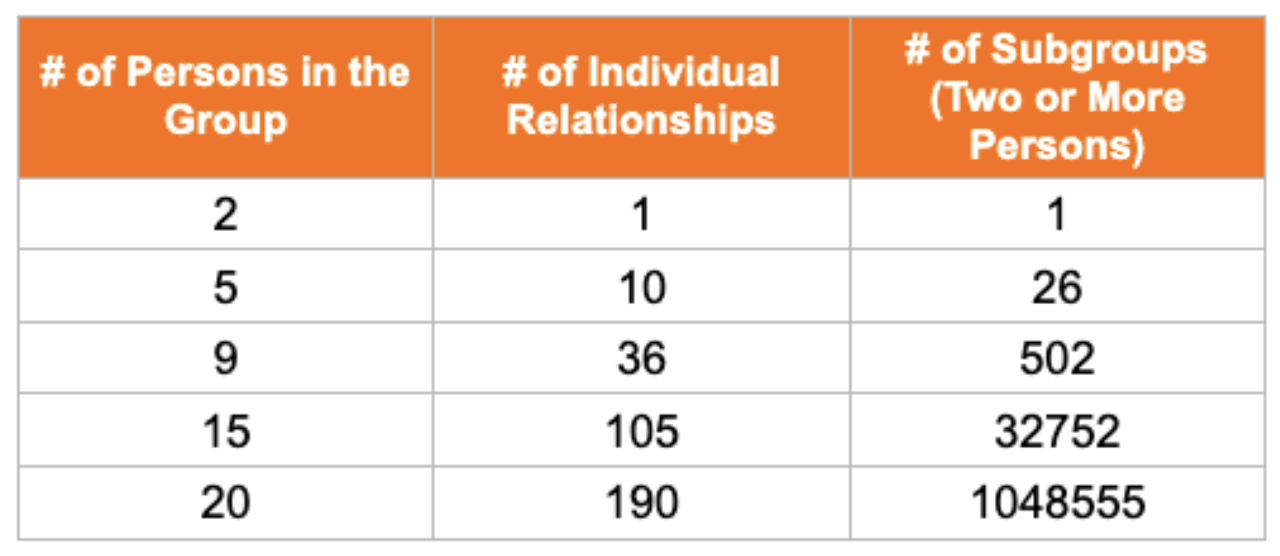
If you want to conduct your own calculations, “n” is the number in the first column:
# of Individual Relationships = n(n - 1) / 2 # of Subgroups = 2n - (n + 1)
Others have put forth simple “rules” like the “Rule of 7” – don’t make your team larger than seven – or the “Two-Pizza Rule” – if you can’t feed a team with two pizzas then the team is too large.
So, what’s the very simple take-away from all of this? Be very careful about growing the size of your board.
How Large Should Your Board Be?
Let’s get back to this original question, which I’ve been asked many times over the years.
As it turns out, there’s no one good answer and it varies wildly by organization.
The bylaws of some of our clients – especially associations and governmental agencies – specifically define the numbers of different constituencies that the board composition must reflect. So, unless you change your bylaws, this may mean that you have no choice but to have a board of twenty or more members.
If you’re required to have a large board then you’re faced with simply trying to make it as effective as possible. (A common solution is to create an effective committee structure that builds engagement and allocates responsibilities. Here is our blog article about this: “Five Tips for Running Successful Board Committees.”)
If your bylaws aren’t as prescriptive and, especially, if you run a small- or mid-sized organization, then my guidance is that your governance should have a two-part structure:
A board of directors of five to nine members, and
A complementary advisory council of up to fifteen persons
Regarding the board, five to nine members can:
Be nimble and respond rapidly.
Catalyze a stronger relationship between the executive director and board.
Simplify board communication and processes.
Have nearly 100% participation.
Lead to a much more coherent board culture.
While that may sound good, how can a board of this size effectively assist with all of those other things (fundraising, program support, marketing, legal guidance, etc.) that boards sometimes do?
Well, that's where a complementary advisory council comes in.
In the two-part structure – a board of directors and an advisory council – the board focuses on governance, budgeting, strategy, etc. while the advisory council simply serves as a loose group of stakeholders that can be called upon as needed.
The key phrase in that last sentence is “a loose group.” Since you probably already have your hands full with managing your existing board, the last thing that you want to do is create yet another group of people that have to be managed. With that in mind:
Think of your council as just a group of people that are happy to lend their names and some occasional time or talent to support your organization. They can be listed on your website and other documentation.
You call upon them, as needed.
Your council doesn’t have to meet or have rules and policies.
Be sure to call this group a “council” and not a board. “Council” typically connotes a more informal group than a “board.”
Keep it simple.
If you’d like to learn more about advisory councils then read our article, “A Fresh Approach for Your Nonprofit Advisory Council.”
Here are links to two organizations that have a two-part structure similar to this:
The Pablove Foundation (~ 9 board members and 15 advisors)
The Art of Elysium (~ 7 board members and 6 advisors)
Done well, this two-part structure allows you to get the best of both worlds: a fast-moving, happy, and easy-to-manage board and a strong set of supporting advisors.
Final Thoughts
If you’re considering adjusting the size of your board and/or advisory council, first consider the purpose for each of the groups:
What is the board’s purpose? Is it a working board? A governance board? Some combination? (Here is a foundational Boardsource graphic that lays out the core responsibilities of boards.)
For your advisory council, what is their purpose? Fundraising? Technical guidance? Legal advice? Community engagement? All of the above?
Getting clear on the purpose for these bodies will help you answer the question of how large the group should be.
Having an effective governance structure involves much more than just addressing the size and structure of your board. That said, structure strongly influences behavior so paying serious attention to the size and structure of your board can have a big impact.
Making Strategic Planning Accessible for Every Nonprofit
At Mission Met, we’re making it easier than ever for nonprofit leaders to create impactful strategic plans. Our online course, START, is now just $50—down from $750! Let’s build stronger futures together.
At Mission Met, we believe that every nonprofit deserves the tools and knowledge to create impactful, actionable strategic plans. That's why we've made the decision to lower the price of our online course, START, from $750 to $50.
START is a self-paced course that helps nonprofit leaders create and follow a clear, effective strategic plan. It walks you through each step of the process, providing easy-to-use tools and practical advice to make planning simple and achievable. START is designed to help your team stay focused, work together, and achieve your organization’s goals.
Why the price change? Because we’ve listened to the nonprofit community. We understand that many organizations, especially smaller ones, operate on tight budgets and hiring a consultant isn’t always an option. This adjustment allows us to support a broader range of nonprofits in their mission to create meaningful change in a way that is affordable and impactful.
Our goal has always been to empower leaders like you with the skills to build stronger, more sustainable organizations through strategic planning. By making START more affordable, we hope to remove barriers and extend the reach of this essential training.
Let’s build stronger futures together. Learn more about START today for just $50!
Sign up at www.missionmet.com/start.
Strategic Planning: Your Team’s Secret Weapon or Stress Maker?
We recently had the opportunity to write an article for The Nonprofit Hive titled Strategic Planning: Your Team's Secret Weapon or Stress Maker?. In the piece, we dive into the critical role strategic planning plays in nonprofit success, discussing how thoughtful planning can drive clarity, alignment, and impact—but also how unrealistic or poorly executed plans can lead to stress and burnout.
We recently had the opportunity to write an article for The Nonprofit Hive titled Strategic Planning: Your Team's Secret Weapon or Stress Maker?. In the piece, we dive into the critical role strategic planning plays in nonprofit success, discussing how thoughtful planning can drive clarity, alignment, and impact—but also how unrealistic or poorly executed plans can lead to stress and burnout.
If you're interested in exploring how to make strategic planning a strength for your organization, check out the article here: Strategic Planning: Your Team's Secret Weapon or Stress Maker?

Stop Letting Your Strategic Plan Collect Dust
Spreadsheets and generic tools may handle the basics, but they fall short when it comes to elevating your strategic planning. Read on to discover how Causey can revolutionize the way you plan and execute your strategies.
Strategic plans often start with enthusiasm but end up collecting dust on a shelf. Generic tools like spreadsheets may handle the basics, but they lack the features needed for truly effective strategic planning. Enter Causey—a platform designed specifically for nonprofits to help you not only create plans but also turn them into action effortlessly.
Check out our latest article to read how Causey outshines spreadsheets with built-in expert guidance, time-saving automation, and accountability tools.
Turn Strategy Into Action
Causey bridges the gap between planning and execution, enabling nonprofits to collaborate seamlessly, stay on track, and achieve their missions. Ready to transform your planning process? Start your free trial at www.causey.app.
Discontinuing the Monthly Strategy Meetups for Causey Clients
We’re discontinuing our monthly “Strategy Meetups” due to low attendance. For support, contact help@causey.app (technical) or admin@missionmet.com (strategic planning). Thank you to all who joined—we’re excited to keep supporting your goals in 2025!
As you may know, each month for the last few years we’ve offered a free one-hour “Strategy Meetup” over Zoom for our Causey software clients to connect with our consultants and address strategic questions. We've enjoyed these sessions—hearing your challenges, sharing insights, and building relationships with you.
After much reflection, we've decided to discontinue these sessions. The sessions were sparsely attended, with no clients showing up for around half of the sessions. Further, we believe we can provide even better support in other ways.
Going forward, you can reach out to us for individual support as follows:
Causey-related Technical Questions and Support: email help@causey.app
Strategic planning-related Questions and Support: email or call your consultant or email admin@missionmet.com to get connected with a consultant
In addition, we plan on strengthening our suite of free or low cost resources for you on our Causey and Mission Met websites.
Thank You!
Thanks to everyone who joined us during a meetup. We will continue to be here to help your organization achieve its strategic goals in impactful ways. Drop us a line if you have a question—we’d love to hear from you!
Onward into 2025

Wake Up! Your Strategic Plan is Likely Not as Strategic as You Think
Is your nonprofit’s strategic plan truly setting you up for success, or is it filled with vague goals that lack focus and direction? In today’s fast-moving world, a plan that doesn’t address root causes or incorporate critical trends like strategic partnerships, AI, social media, and technology solutions risks leaving your organization behind. Embracing modern strategies can transform your plan—and your impact. It’s time to wake up, rethink, and position your nonprofit for a thriving future.
A version of this article was originally written for Nonprofit Pro.
In today’s rapidly evolving landscape, nonprofits are under constant pressure to adapt and innovate. Yet, many organizations find their strategic plans lagging behind, failing to produce the desired impact. A major reason is that many strategic plans are filled with vague, surface-level goals that sound good but lack direction and depth. For example:
"Improve our programs to serve more people."
This goal isn’t very strategic. Why do you want to grow the program? Are there specific groups with unmet needs that you’ve identified? Is the challenge with the program’s design, or is it that people don’t know about it? Without clarifying the why and how, it’s impossible to measure success or make meaningful progress."Improve staff retention."
Great, but what’s driving your turnover? Is it burnout, compensation, or lack of professional development? A strategic plan would dive deeper, perhaps outlining actions like “Establish a mentorship program to reduce burnout” or “Conduct a compensation study to ensure competitive wages.”
These goals may be well-intentioned, but they lack the clarity needed to make real impact. A truly strategic plan digs deeper to uncover root causes, define specific objectives, and align actions with measurable outcomes. If your plan is full of these high-level goals with no clear path forward, it’s likely not as strategic as it should be - wasting resources, creating confusion, and likely missing the mark.
Additionally, if your strategic plan doesn’t address today’s key trends—such as strategic partnerships, AI, social media strategy, and technology solutions—you risk falling behind and missing critical opportunities. Let’s dive into how incorporating these elements can take your strategy from good to great.
1. The Power of Strategic Partnerships
No nonprofit is an island. Collaborating with other organizations, businesses, or government entities can exponentially increase your reach and effectiveness. Strategic partnerships allow you to pool resources, share expertise, and tackle challenges together that would be impossible to address alone. These partnerships can also open up new funding opportunities, expand your network, and enhance your reputation within the community.
Why it matters: In a time of shrinking resources and increasing competition for funding, strategic partnerships can provide the leverage needed to achieve your mission more efficiently and effectively. If your plan doesn't include clear objectives and tactics for building and maintaining these relationships, you're missing out on a critical element of long-term success.
Here are a couple goal examples from our customers:
“Identify and conduct outreach to potential NPOs that focus on area youth to form strategic partnerships, ideally in education and literacy.”
“Conduct outreach to develop a minimum of 2 corporate partnerships with companies/brands that share a similar mission.”
2. Embracing AI for Greater Efficiency and Impact
Artificial Intelligence (AI) is no longer a futuristic concept; it's a tool that your nonprofit can use today to enhance your operations and outreach. From automating routine tasks to analyzing large datasets for more informed decision-making, AI can help your organization work smarter, not harder. For instance, AI-driven tools can personalize donor engagement messages, predict donor behavior, and optimize fundraising strategies, leading to better results with less effort.
Why it matters: AI is rapidly becoming a differentiator for organizations that can harness its power. Nonprofits that fail to incorporate AI into their strategic plans risk being left behind, as competitors become more efficient and effective in achieving their goals. If your strategic plan doesn’t address how AI can be integrated into your operations, it’s time to start exploring the possibilities.
Here’s an example:
“Implement AI-driven tools to personalize donor outreach, predict giving patterns, and identify lapsed donors, increasing donor retention and lifetime value by 15% over the next two years.”
3. The Necessity of a Comprehensive Social Media Strategy
Social media is more than just a platform for sharing updates; it’s a powerful tool for engaging with your community, raising awareness, and driving action. A well-executed social media strategy can amplify your message, attract new supporters, and deepen relationships with existing ones. But to be effective, social media efforts must be strategic, consistent, and aligned with your organization’s overall goals.
Why it matters: In today’s digital world, a strong social media presence is essential for staying relevant and reaching a broader audience. Without a clear plan for how to leverage social media to support your mission, your organization may struggle to connect with potential donors, volunteers, and partners. If your strategic plan doesn’t include a comprehensive social media strategy, you’re missing a key piece of the puzzle.
Here’s an example from one of our customers:
“Review the social media policy annually with the communications committee and assign each person a role in covering the content calendar, responses, and engagement.”
4. Finding the Right Technology Solutions
Technology is at the heart of modern nonprofit operations, from managing donor databases to facilitating virtual events and streamlining internal processes. However, not all technology solutions are created equal, and finding the right tools that align with your organization’s needs is crucial. Investing in the wrong technology can lead to inefficiencies, wasted resources, and missed opportunities.
Why it matters: The right technology can significantly enhance your nonprofit’s ability to execute its mission effectively. Whether it’s a CRM system that helps you manage donor relationships more efficiently, a project management tool that keeps your team on track, or a strategic planning execution software like Causey, technology should be a strategic component of your plan. If your strategic plan doesn’t include a clear approach to evaluating and implementing the best technology solutions, you risk falling behind in a tech-driven world.
Here’s an example:
“Evaluate and implement scalable technology solutions that align with our goal to automate high-volume tasks and reduce operational costs.”
Tell us more
Is your organization’s strategic plan lagging? We’d love to learn from your experiences! Please take a moment to share your thoughts by participating in our brief survey here. Your insights will help us better understand the roadblocks nonprofit professionals encounter and shape future resources that address those needs. Together, we can build strategies that truly make an impact.
Conclusion
Your strategic plan is the roadmap to your organization’s future success. But if it doesn’t include the latest trends in strategic partnerships, AI, social media, and technology solutions, it may not be as strategic as you think. By incorporating these elements into your planning process, you can ensure that your organization is well-positioned to thrive in the years ahead. It’s time to wake up and re-evaluate your strategy. The future of your nonprofit depends on it.
Exciting Updates to Causey: Designed to Save You Time and Boost Collaboration
We’re thrilled to unveil the latest enhancements to Causey, crafted to streamline your strategic planning and empower your team. Here’s what’s new.
We’re thrilled to unveil the latest enhancements to Causey, crafted to streamline your strategic planning and empower your team. Here’s what’s new:
Custom Date Ranges in Reports: Create tailored reports for any time frame to better meet your organization’s needs.
Add Metrics on the Fly: Seamlessly introduce new metrics directly from your plan without breaking stride.
Easily Adjust Groups of Dates: Update timelines for entire focus areas in just one step.
Actions View for Task Management: Stay focused with a view that organizes tasks by assignments and progress.
Collaborative Comments: Keep feedback and discussions all in one place with comments on most plan elements.
These features are built to save you time, improve your workflow, and enhance collaboration.
Read the full announcement to see how they work and log in today to explore the updates firsthand.
Here’s to a more strategic, productive, and impactful year ahead!

A Simple and Powerful Way to Kickstart The Engagement of Your Chamber or Association Board
When a statewide organization found its board disengaged and its results falling flat, they turned things around with one simple but powerful strategy: restructuring their strategic plan around six focused committees. Discover the power of committee-driven planning and how it can transform your organization too.
Several years ago I was hired by the great folks at the California Hispanic Chambers of Commerce to help them create their next strategic plan.
In my assessment conversations with the CEO and board leadership, they shared a persistent and painful problem that they had regarding engaging their board. The board members, as great as they were, just weren’t showing up or following through consistently enough. And the staff didn’t have the bandwidth to effectively engage them. As a result, the fundraising results, events attendance, membership numbers, and board culture were suffering.
I had seen this same challenge in many other organizations and really wanted to find a solution.
We decided to implement one simple strategy: to deliberately structure their strategic plan around six committees. Rather than identifying broad “focus areas” like operations and fundraising, we created sections of their plan that correlated to six committees:
Governance
Finance and Revenue Generation
Advocacy
Events and Programs
Membership
Branding and Reputation Management
Committees, in theory, are a great way to build engagement. They provide specific projects and create opportunities to build relationships with other board members. However, committees are famous for their ineffectiveness if they’re not clearly directed or well-managed. The hope was that by building the strategic plan around the committees, the committees would function well and the board members would commit to regular involvement. We have written about committees before and provided tips for running them.
Within each of the six committee areas on the plan, we documented the purpose and responsibilities of the committee and a small set of annual goals that they’d pursue. We identified who would champion (lead) the committee, often relying on a co-champion model to provide stronger support and accountability. The committees worked on specific and measurable goals between board meetings while the staff and I provided support.
So, what have been the results? Well, recently I facilitated their annual planning meeting and here’s what I experienced and learned:
A Brand New Board Culture
When I walked into the meeting room, I felt a joyful culture that they had created. Everyone was engaged and were happy to see their colleagues that they had been working with on their committees. In fact, every single one of their twenty-one board members was in attendance, and that’s for a statewide organization of leaders scattered across the large state of California.
As a past board chair said at the beginning of the retreat, “we’ve built trust.”
More Efficient Board Meetings
Their board meetings have been cut down to about one-third as long as they used to be since the board members don’t have to discuss everything as a full group. They trust that their colleagues in the committees are doing good work.
Greater Fund Development Results
The organization has tripled its overall revenue, had an eight-fold increase in revenue from corporate memberships, and a doubling of revenue from events.
Stronger Membership
They’ve increased the number of chamber members from around 50 to over 130.
Given this experience and other, similar experiences with other organizations, I’m convinced that organizing your strategic plan around committees can be a great strategy to build board engagement and get better outcomes and results.
Here is an example of a plan for a fictitious association that shows how this structure can look. (This plan is captured in Causey, our strategic planning software.)
We’d love to help you create your strategic plan around this committee-based format. Don't hesitate to reach out to us.