
How Risk Assessment Plays a Key Role in Strategic Planning
When it comes to strategic planning for nonprofits, one of the key factors to consider is risk assessment. By understanding the potential risks and rewards associated with various actions, nonprofit leaders can make more informed decisions about where to allocate resources.
This article will discuss how risk assessment is used in strategic planning for nonprofits, as well as some of the next steps.
Strategic Planning and the CAPE Cycle
Nonprofit strategic planning is an essential tool for any organization looking to increase its effectiveness and make a lasting impact. It involves setting goals, developing strategies to achieve them, and creating systems for monitoring progress towards those objectives.
Strategic planning also helps organizations identify opportunities that can help them reach their desired outcomes more quickly or with greater success. By taking the time to create strategic plans, nonprofits can ensure they are making the most of their resources while achieving maximum results.
At Mission Met, we view strategic planning as a cyclical, never-ending, four-step process that we call the CAPE Cycle. As indicated in the graphic below, CAPE is an acronym for the four strategic planning steps: Champion, Assess, Plan, and Execute.
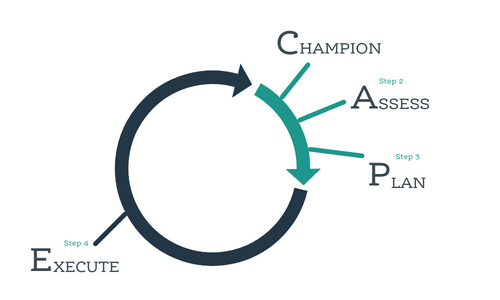
The second step of Mission Met’s strategic planning process is Assess.
The first and most obvious reason for the assessment step is to gather information about your organization and the environment in which it operates in order to create a relevant plan. Without that information then you’ll just be throwing darts in the dark.
The second and less obvious reason is that conducting an assessment serves as an excellent way to engage others and create buy-in for your strategy. There’s a saying that we use with our clients: “People support that which they help create.” You’ll learn more about the organization if all team members and key stakeholders provide input.
Assessing Risk in Your Nonprofit
Managing risk in your nonprofit can be a challenging but highly beneficial undertaking. Taking steps to properly assess and manage risk can help you anticipate and prepare for a variety of situations, allowing you to remain resilient regardless of what challenges may arise.
Risk agility also means that your organization is working efficiently while upholding its values and mission. This is essential in order to build trust with stakeholders and donors. Furthermore, engaging in holistic risk management can lead to more strategic decisions as well as increased cost savings down the line.
Risk assessment involves looking at both internal and external factors that may affect an organization’s operations or ability to achieve its goals. Internally, this includes analyzing financial statements in order to identify potential liabilities and areas of concern as well as evaluating staffing levels and organizational structure. Externally, risk assessment requires considering possible changes in the environment or legal landscape which could impact operations such as new regulations or changing donor preferences.
Assessments can be done in a variety of ways. You can assess risk and then make a plan by prioritizing how to respond to those risks. You can also assess strengths and opportunities.
A well-known analysis that assesses both is the SWOT analysis which finds the strengths, weaknesses, opportunities, and threats. Risk Alternatives offers a sophisticated four-step assessment process that identifies risks, both negative and positive, and helps determine how to address them.
What’s Included in a Risk Assessment?
We include topics and questions during an assessment that will capture where your organization is today and clarify your vision for the future (we typically suggest a vision for three years in the future). The action steps to get from where you are today to the three-year vision become part of your strategic plan.
First, capture key information about your organization’s programs, income, and people:
Include brief descriptions of all your services and programs and key metrics for those programs.
What is your estimated income for this year? What was it last year?
How many employees, contractors, board of directors, and volunteers do you have?
Next, review your organization’s processes and procedures for financials:
Do you have an annual budget? Do you have a multi-year budget?
Do your budgets set aside operating reserves?
Do you have a financial team or committee that regularly reviews your finances?
Do at least two people on your team have access to financial records and know how to create reports?
Do you have financial policies and procedures documented?
Does your board provide effective oversight of your financials?
You can also assess your organization’s current capacity in a variety of topics such as programs, board management, and fundraising. Additionally organizations may assess psychological risks including poor morale, stress or lack of motivation among team members.
A three-year vision will answer these types of questions:
What will your organization’s programs/services consist of?
How many staff members do you hope to have and what will their roles be?
What will your budget and expenses look like?
There are a number of ways you can conduct an assessment but these basics are a starting point.
Next Steps
After receiving responses from your assessment, analyze the threats and opportunities and determine the priorities for your organization. A consultant can help you pull out themes and prioritize the most urgent.
Often, themes will be abundantly clear. For example, if you have a new CEO, you may want to focus on the leadership transition. Or maybe you’ve recently been audited so we would recommend financial management as a priority.
After analyzing this information and identifying your themes, you can move to creating specific and measurable goals. This moves your team into Step 3 of the CAPE Cycle, the actual creation of your strategic plan.
Conclusion
Risk is an inevitable part of running a nonprofit organization. Being aware of potential risks and taking steps to minimize the negative and maximize the positive is key to protecting both your organization and your stakeholders while making the most impact in your community.
Through thoughtful planning and regular monitoring, you can face risks head on—and come out ahead!
Nonprofit Executive Director Reviews: Where to Start
For a nonprofit executive director, performance reviews can be a great opportunity to reflect on accomplishments and set goals for the future. Want to know the best way to begin a nonprofit executive director review? Here is an explanation of a best practice and a template.
Performance reviews can be a great opportunity to reflect on accomplishments and set goals for the future.
As strategic planning consultants, we have helped guide both executive directors and board members through this process and this article will hopefully help you with your executive director review.
What is a Nonprofit Executive Director Review and Why is it Important?
A nonprofit executive director review is an assessment of the performance of the executive director of a nonprofit organization. The review evaluates the director's success in accomplishing objectives such as developing relationships with key stakeholders, strategic planning, and financial management.
The outcome of the review is important because it serves as consensus-building between board members and the executive director, as well as benchmarking progress over time.
Best practice
An effective review should be conducted regularly, encompassing input from both internal and external parties. The results should lead to a comprehensive evaluation of organizational performance and guide future decision-making in support of your mission and vision.
It’s vital that the parties involved in the review consider new strategies and discuss organizational challenges, innovative opportunities, and any potential risks or threats to the organization in order to plan ahead.
One of the best practices is to self-assess and rate your performance before discussing the results with the board.
For the executive director to take the first step and complete an initial review, it helps provide an avenue for open dialogue between you and the board. It allows your own voice and perspective of your job achievements to stand out during the review meeting. The ability for reviewees to have input upfront can provide a level playing field that is necessary for making sure that the performance evaluation process is collaborative, engaging, and motivating.
A template
In following the best practice, we recommend the executive director take responsibility for their review and assessment first by completing a simple worksheet and assessment we developed.
This form is not a generic assessment; it is specifically based on your job description. (If you don't have a written job description then that is the first task.)
It forces you as the executive director to take responsibility for your own review and assessment, which is better than just having the board evaluate you. This opens up a line of communication between you and the board. It allows you to have a say in your review and provides a channel for the board to respond and provide feedback.
Results
Conducting your review this way results in something practical -- a development plan for you -- that you'll review and track with your board chair over the next year.
It’s important to start by assessing the results of the review after completing the worksheet. Assessing staff reaction, team cohesion, and ED performance will help provide clarity on what areas need improvement and whether further action is necessary.
It might also be beneficial to compare the results with past reviews or milestones that have already been achieved in order to improve success rates in the future.
After these processes have taken place, implementing new strategies for better collaboration and fostering successful relationships both within an organization and with external parties should be considered. This can help ensure confidence in the future for both the ED and their colleagues as they move forward with their mission.
Conclusion
A nonprofit executive director review is an important tool for assessing performance and progress within the leadership of nonprofit organizations. This provides an opportunity to take a step back and reflect on the organization’s successes with you as leader, as well as areas that could use improvement.

Nonprofits Need Risk Management
This guest post was written by Ted Bilich. Even in the best of times, nonprofits confront numerous challenges. But these are not the best of times. So what steps should a prudent nonprofit leader take to chart a course forward? In addition to strategic planning, nonprofits need basic orienteering tools to manage the journey. I suggest three: a risk management process, a business continuity plan, and scenario planning.
This article was written by Ted Bilich, CEO of Risk Alternatives LLC, located in Arlington, Virginia. Risk Alternatives works with nonprofits and entrepreneurial organizations to help them identify and address threats and opportunities, confront challenges, and put processes and systems in place to achieve their goals. Ted’s mission is to build stronger communities by helping to build sustainable nonprofits and healthy, scalable small businesses. Ted has more than 25 years of experience counseling clients on risk management and complex business issues.
Even in the best of times, nonprofits confront numerous challenges. But these are not the best of times. Facing a world of hyper-partisanship, economic uncertainty, racial unrest, ongoing war, and unpredictable climate change, the average nonprofit leader has her hands full. So what steps should a prudent nonprofit leader take to chart a course forward?
Strategic planning, of course, is essential. A nonprofit needs to understand which mountains it intends to scale and how it intends to measure progress along the way. But in addition to strategic planning, nonprofits need basic orienteering tools to manage the journey. I suggest three: a risk management process, a business continuity plan, and scenario planning.
Nonprofits Need Risk Management
As I lay out in my new book, Managing Your Nonprofit for Resilience, every nonprofit should have a process in place to identify and address threats before they become crises and opportunities before they pass the organization by. If your nonprofit does not yet have a risk management process in place, consider using the method set forth in that book.
You begin with a risk inventory – a team exercise where participants look for risks in all functional areas of the nonprofit, as well as your external environment. You then prioritize those risks and capture them in an accountability document called a risk register, which staff can use to track progress in addressing those risks. Finally, you incorporate a “risk cycle” in organization to ensure that risk management is not treated merely as a one-time event, but instead is a living part of organizational culture.
A nonprofit that institutes the process just described will have a much better understanding of its current capabilities. It will also encourage all staff members to think like leaders and speak up about things that worry them and opportunities for positive change.
Nonprofits Need a Business Continuity Plan
Even the best risk management process, however, will not anticipate every potential contingency. In wintertime, pipes might freeze, ruining your office. A crazy active shooter might endanger your staff and clientele. A phishing attack may render your computers unusable. No matter what the business interruption might be, your nonprofit needs a simple, robust, business continuity plan that tells staff how to operate in an emergency.
A business continuity plan cannot be a lengthy, exhaustive document. Back in 1989, first responders in Prince William Sound, Alaska, had a 1,000+ page emergency plan in case of an oil spill. Predictably, that plan was of little value when the Exxon Valdez ran aground and began spewing oil into the pristine waters. The “plan” was simply too big, too complex, and too specific.
Instead of a mammoth document that attempts to contemplate and address all possible contingencies, a solid nonprofit business continuity plan should be extremely short – no more than about 10 to 15 pages. (You can find a template here.) It should note, for example, who should be made aware of the emergency, how that will be accomplished, and what the nonprofit would like to do in any emergency within the first few hours and days of any emergency incident. It should list important emergency contact information (insurers and policy numbers, first responders, legal counsel, and so forth.)
Imagine your nonprofit had such a document, and that it resided as a PDF on the smartphones of all staff members. In an emergency, all of your staff would be literally on the same page.
Nonprofits Need to Engage in Lean Scenario Planning
A nonprofit with a risk management process and a business continuity plan would feel much safer and more agile in the face of uncertainty. One additional tool, however, can provide additional clarity and comfort: scenario planning. In scenario planning, a nonprofit imagines possible future events in order to make better decisions in the present.
When we help clients perform scenario planning, we urge them to imagine various scenarios, such as the sudden exit of a senior leader, a significant reduction in funding, or a significant increase in budget resources. For each scenario, participants ask three questions: (1) How likely is this scenario? (2) If this scenario came about, what would we want to be ready to do at that time? (3) Given the answers to the first two questions, what if anything do we want to be doing now to increase our ability to respond appropriately if this scenario comes true?
By using those three questions, in order, a nonprofit can identify areas of leverage – small steps that can be taken now that could lead to big payoffs down the road. Equally important, participants in this exercise may gain insight into potential vulnerability before it’s too late.
Conclusion
Take these three steps – create a risk management process, adopt a business continuity plan, and engage in scenario planning. You will make better decisions every day, and you’ll also sleep better at night.
Max ERTC helps you meet your mission!
Haven't taken advantage of the ERTC program yet? It's not too late, but it's time to take action.
Max ERTC makes applying for this federal program simple and painless.
In this webinar, you will learn the following:
How you can receive a refund on the payroll tax on employees you retained during 2020 and 2021 - the amount is often similar in size to the PPP loan.
How you should act rather quickly: the deadline is to apply within three years of a quarter’s eligibility, so quarters will stop counting toward eligibility as early as March 2023.
How MaxERTC makes it easy to qualify and apply for a refund.
How the minimum number of employees you need is ONE, so all nonprofits are eligible.
The timeline and process for qualification and reimbursement.
Next steps?
Collect your 2019, 2020, and 2021 gross receipts (i.e., total income) and submit to https://www.maxertc.com/missionmet.
Alternatively, if you have any questions about the process, email Ian and Chris at (info@maxertc.com) or call (216) 302-8966 and tell them Mission Met sent you.
MaxERTC is a trusted partner of Mission Met. Mission Met never has access to your sensitive financial information.

Fundamentals of Training and Developing Your Nonprofit Board
Nonprofit board training should be a priority for all organizations that want their board to be impactful. Here are some fundamentals for effective training and development:
Your nonprofit board plays a pivotal role in how well your organization does as it pursues its mission.
One area that all nonprofits should prioritize is the ongoing development of board members, so they’re in the best position to serve successfully. Well-trained board members understand their role and how they can make a positive impact. They work as a cohesive unit and help the organization run more efficiently.
Ongoing development also helps the board member feel valued as a team member. It can make the difference between members who serve as committed advocates for the organization and those who leave after a short period.
Here are our fundamentals for training your nonprofit board:
Provide the Basics with Effective Onboarding
Initial onboarding is one of the most critical periods for new board members. It’s when they form their impression of your organization and how things work, for better or worse.
Having a formalized process for onboarding is something all nonprofits should embrace because it’s an opportunity to build a strong foundation. When there isn’t a standardized process, new board members often get inconsistent training and may not learn everything they need. A thorough orientation should set board members up to be successful in their roles.
What sorts of “basics” should you cover in onboarding? Here are a few key areas:
The mission, values, and history of your organization.
A who’s who of all board members and key staff. What are their roles? What are their areas of expertise?
The board member's job description and expectations.
Any expectations around fundraising or giving.
The board member agreement.
Key policies and procedures. For example, conflict of interest, the board’s role in managing senior executives, bylaws, financial reporting, travel reimbursement, etc.
The most recent annual and financial reports.
The organization’s strategic plan.
The board roster and any committees.
A calendar of planned meetings and events.
Any tools or technology that the member will need to use.
The goal of this phase should be to get the new board member engaged and able to work effectively as quickly as possible.

Know the Rules
The rules governing how nonprofit boards operate vary from state to state. It’s helpful to include training on the legal duties of board members within your state. Board members often don’t automatically know the ins and outs of state law, including which duties apply to which states.
Fortunately, most states have some sort of guidance available for nonprofit boards, which you can usually find online. For example, Ohio’s guide for charity board members and California’s are online.
There are also board rules and responsibilities that members should know that don’t relate to the state in which you live. BoardSource provides the ten basic responsibilities for boards which include topics such as establishing organizational identity, ensuring resources, and providing oversight.
Encourage a Culture of Continuous Learning
Boards often consist of a mixture of long-serving members and new board members. Regardless of years served on your board, all members will benefit from training and development. People often find refreshers useful, or they may learn something new. Including all board members is also a great way to help new members get to know their colleagues.
Some nonprofits organize regular training meetings for their board members to keep knowledge and skills current. Governance is a major priority; sometimes, things might change, or not all members have had the opportunity to learn all areas. Some ideas for governance training topics include:
Board member job descriptions.
Financial reporting and responsibilities.
Fundraising strategies.
Strategic planning.
How to share and spread the mission of the organization.
Rules for facilitating board meetings. For example, some boards use Robert’s Rules of Order, which govern every situation a board may encounter.
Networking with donors and business professionals.
Evaluating performance (the board’s and the executive director’s).
Facilitating meetings.
Media and communications training.
Training and development for the board member role shouldn’t be a one-time event; it should be an ongoing effort to ensure that board members have what they need to be effective. Even the longest-serving members usually have something more to learn!
Train for Board Committees
If your nonprofit runs separate board committees, it’s important to tailor training and development for them. These opportunities are a way to ensure your board committee is operating effectively and efficiently.
Highlighted in a previous article about running successful committees, board members should have a clear understanding of their roles and responsibilities. They should know the mission and goals of the committee and how they can use their skills to further that mission.
Board committee members may need training on researching, making recommendations, and presenting to the wider board. They should also learn about what each committee does so they know how to best support them.
As a general rule, committees should be “right-sized” to streamline decision-making. Large committees can have challenges making difficult decisions as a unit, while small committees can find that they don’t have sufficient resources to be effective. It can be a good idea to cover these potential challenges in board committee training. Awareness can help members recognize when they might be facing a similar challenge.

Regularly Compile Training Resources
There are several excellent resources for board members’ continuing education. These come in all sorts of formats, including self-paced training online. Compiling resources so that board members can access them as needed is potentially helpful. Some sources to check out include:
State associations of nonprofits. These will often offer programs in a variety of formats for board members.
Peer-to-peer learning presented by board members from other nonprofits.
The Nonprofit Risk Management Center. This organization provides resources to help board members understand liability insurance and risk management issues.
If you have contacts specializing in specific areas, keep a record of their details and expertise as part of your training resources. Someone down the road may find it helpful to tap into a resource directly.
Conclusion
Just like strategic planning is a process, so is providing training and education to all members of your nonprofit team, including board members. Educating board members should be a priority during onboarding and throughout their tenure as board members. Encouraging a culture of continuous learning will empower board members to be effective in their roles.

How to Grow an Effective Remote Culture
Does your nonprofit work remotely? Building an effective remote culture will help it to thrive - here’s how to do it:
Does your nonprofit work remotely or with a hybrid structure?
If so, it’s just as important to pay attention to your team’s culture and how it may be impacted by remote work as it is to develop a strong culture when you’re in the office. While many nonprofits offered remote work pre-Covid, many others found they had to adapt how they worked due to the pandemic. The impact remote work has on culture may surprise organizations.
Remote work brings many benefits, such as better flexibility for team members, cutting back on commutes, and, according to various studies, higher productivity.
On the flip side, growing an effective organizational culture while working remotely is one of the common challenges. Some organizations have struggled, finding that going remote has negatively impacted the culture they built previously.
This kind of impact doesn’t have to be the story of remote work; it shouldn’t be the story of remote culture for your organization. Here’s what you can do to grow an effective culture:
Common Challenges with Remote Culture
One of the most significant impacts of remote work on culture is that people simply don’t see one another anymore and engagement levels drop. Culture naturally develops in an office or other in-person settings as people interact and normalize “how we do things around here.” It’s vital to note that whether you intentionally develop the culture or not, your organization will have a culture.
Values such as teamwork and overall camaraderie tend to be simpler to manage when everyone gets together. There are more casual “water cooler” conversations that help people build engagement, respect, trust, and support.
When everyone works remotely, it’s easier for people to miss out on those connections. Sitting behind a computer can lead to employees focusing more on their tasks than their team. They might lose touch with what’s happening in the group and perhaps not feel as connected to people.
For your nonprofit, those connections are critical if you want your team to work successfully together toward your mission. A healthy organizational culture should be part of your overall strategic plan. When working remotely, find ways to engage your team.

Tips for an Effective Remote Culture
The good news is that with some best practices in place, you can develop a strong, healthy culture, even among a remote-based team. Below are some tips to help make that happen.
Set Up the Right Systems
HelpScout’s Nick Francis says: “A culture’s effectiveness revolves around how information flows. Everyone needs to feel like they have access to the same information, but remote and co-located cultures share information differently.”
In a remote environment, your channels of communication become more important than ever. You must have systems and tools in place that make the exchange of information easy for your team, and promote keeping everyone in the loop. There are no impromptu stand-up meetings or chats as you pass by someone’s desk. Your online communication channels need to serve those purposes.
We commonly rely on email, but it doesn’t cut it as a tool for facilitating easy information flow in a remote environment. “Chatting” via email can be awkward. Inboxes are often overflowing, and it’s easy for important messages to get buried.
Consider your needs for remote meetings and enhance the ability for people to chat. Apps such as Slack tend to stand in nicely for chat, but you should have a structured setup of channels so that conversations are easy to track. It’s less effective for more complex discussions.
For remote meetings, video calling apps can help everyone put a face and voice to each name. Zoom usage boomed over Covid, but other apps are also worth considering.
What about keeping track of projects and resources? A project management tool tends to be the best way to keep everything in one centralized spot. They have the advantage of giving a clear overview of project status while ensuring accountability is maintained by assigning names and due dates to tasks.
Mission Met Center is a tool that documents and tracks your nonprofit’s strategic plan. Inviting all team members to view and engage in the organization’s strategy will help foster a positive culture where everyone feels their voice can be heard and it is valued.
Have Clear Policies and Practices
You want a remote culture where people follow standard policies and practices, developing a shared understanding of what team members should be doing. Handbooks are a great place to share this information. Some particular things to be clear about include:
Expectations around availability. If you have flexible working hours, are there times when people must be available? What about communication outside of work hours? It’s easy for people to pick up phones or laptops and check in at weekends or during evenings. Still, if that’s not necessary, it’s essential to discourage communication during this time. When people see an email sent on Friday evening, they may feel pressure to respond because they’ve seen it. Not having enough time to “switch off” is a common cause of burnout.
Expectations around when and how to communicate. For example, on projects where one person must complete a task before handing it to the next person for their part, how should they communicate? How should people communicate (and to whom) if they need to take a sick day or sign off early?
Communication response times. How soon do you expect a response? When do you not expect a response? (E.g., evenings and weekends). As with a co-located office, you should also have policies to protect team members from unwanted communications (such as shares that are “not safe for work”).
Communication with clients and donors. You need a shared understanding of how to communicate with donors and clients. Your organization should aim to give a consistent experience.
Security and technology. What are your policies and practices around system security and looking after the organization’s own technology?
Training and storage of information. How will information be stored so that people can access it if necessary? What will you do when onboarding new team members to ensure they feel part of the team and get access to the information they need? Consider that having access to the information necessary to help them do their job well is a key component to people feeling comfortable in their roles.
Developing a remote team culture? Clear policies and practices are important for getting everyone on the same page.

Have Regular Check-ins
There’s always a danger of team members feeling isolated when they work remotely. You’ll have some people who absolutely love it, while others wish they could have some more “people time.” Regular check-ins can help everyone to stay motivated, no matter how they feel about working remotely. A few practices that some remote-based nonprofits have in place include:
Morning kickoff meetings. This tends to be short - no longer than 15 minutes - and is used to set up the priorities of the day, and report back on anything from yesterday.
Weekly or fortnightly meetings. A “meeting for the sake of a meeting” doesn’t tend to have positive impacts on team culture, so if you don’t need daily meetings, sometimes weekly or fortnightly will do. The idea is still to get your team face-to-face.
Encouraging team members to keep an up-to-date status on apps such as Slack. For example, you can show yourself as active, away, or busy.
Don’t forget the importance of 1:1 meetings where an employee and supervisor can build a positive work foundation. The 1:1 should be an opportunity to get to know each other well and provide a forum where everyone can safely speak up.
Find Ways to Foster Teamwork
Co-located teams tend to do things such as have celebrations at the office or even socialize outside of the office. This helps them to develop those casual relationships that can build a strong culture.
You can take some of these concepts and bring them to the remote environment, too. For example, celebrating success is still just as important. It can be as simple as making a congratulatory announcement, or you could arrange a remote team lunch or coffee break.
Some other ways teamwork can be fostered remotely include:
Team challenges. Things such as trivia quizzes or show and tell are fun ways to start meetings.
Team meet-ups. Consider arranging in-person meet-ups or team retreats. These can be great for helping develop strong relationships. If keeping things remote, host a lunch get-together where everyone can eat and chat about nonwork related topics.
Surprise treats. You could surprise team members at random with small tokens of appreciation. Coffee vouchers or gift deliveries are common but you don’t have to spend money to show a team member they are valued. Consider praising individuals in team settings or offer professional development opportunities.
Survey your team to find out what interests them. Most people don’t like “forced fun” environments, so find some activities that people have genuine interest in.
Conclusion
Remote work can make maintaining a solid culture challenging, but you don’t have to sacrifice culture to have a remote-based team in your nonprofit.
Having the right tools, systems, processes, and practices to foster communication and teamwork can go a long way toward developing a solid culture. Of course, as nonprofit leadership, you need to show up too. You need to be active and intentional about “showing the way” toward the type of culture you want to build.
Lastly, remember the interrelationship between culture and strategy. Your strategy will absolutely be impacted by your culture and vice versa. Include cultural planning in your strategic plan to ensure your remote team is at its most effective.

Which Operational Model Describes Your Board?
Which board operational model describes the governance of your nonprofit? Here’s a breakdown of typical models:
All boards share a common set of responsibilities. That said, what is the right model for how your board actually operates?
As a nonprofit leader, you should know and care about the type of board you have and the responsibilities of each member. This information can offer clarity about your important work and help guide key decisions.
Every nonprofit board will fall broadly under one of these two descriptions: a working board or a governing board.
Working Boards
A working board is the typical model for small nonprofits with a limited budget and no or minimal staff. In this model the board does the bulk of the work. A working board is sometimes also called an operational board.
The duties and makeup of working board members may look different depending on the organization's needs. There will generally be a chairperson and treasurer, along with roles such as volunteer coordinator, marketing coordinator, membership coordinator, and secretary. It is helpful for board members to have expertise in these areas if they fill a specific role. All members should have strong project management skills to stay on top of the tasks required.
As an organization grows and develops a larger budget and staff, the board typically evolves from a working board to a governance board.
GovernANCE Boards
A governing board focuses on strategic oversight rather than doing the day-to-day work. Like a working board, the governing board is responsible for ensuring the organization works to meet its mission and complies with required governance.
Governing boards work with the executive director and hold them accountable for their performance.
Common governance boards include the cooperative governance model, the Patron governance model, advisory board model, and policy governance model (sometimes referred to as the Carver model.)
Board variations
Both operational models may apply to your nonprofit in some combination. Nonprofits may opt for some sort of mixed governance model to suit their specific needs. There are no “rules” for setting up your model, as long as you meet your legal requirements.
For example, some will have a working board and will bring in an advisory council. Or, they might have a corporate governance model but still form sub-committees for things like fundraising. In an age where flexibility and a willingness to pivot have been critical for nonprofit survival, being willing to update operational models has been vital for many nonprofits.
clarity of responsibilities
Regardless of the model, here are some of the key responsibilities your nonprofit staff and board need to have clarity on to operate effectively:
Who hires, oversees, and fires staff?
Who creates and executes the strategic plan?
Who runs programs?
Who is responsible for raising money?
Who manages our money?
Who addresses legal compliance?
Who manages volunteers?
Who creates and executes marketing?
Who manages our facilities?
There are many more responsibilities that could be listed here but the main point is to collaborate on and then document who does what within your organization.
When executive directors know the key responsibilities of their staff and board, it reduces confusion and improves work effectiveness. When board members know their key responsibilities it leads to good governance. Combining the two leads to a greater impact on your mission.
Conclusion
Board members play significant roles for nonprofits and good governance is an essential success factor for nonprofits.
Your board needs an operational model that allows them to perform optimally. Boards should not be static. They must change and evolve as their organizations do. Finding the most suitable operational model will help your nonprofit run effectively and smoothly.

A Basic Nonprofit’s Guide to Buying Property or Buildings
Buying property for a nonprofit can be an exciting and challenging step. Here are some factors that organizations should consider when embarking upon real estate transactions:
Does your nonprofit require a physical space from which to work or provide community services?
Many nonprofits must choose between leasing a suitable space or buying one. While the property market can be tricky to navigate at times, you may be in a position to buy, either with cash or via a nonprofit mortgage loan.
If you decide to purchase property or buildings for your nonprofit, this basic guide is for you. We’re looking at why buying property might be beneficial and some tips you should know about real estate shopping.
Why Would Nonprofits Buy Property?
First, let’s dive into why purchasing property can benefit nonprofits. Here are a few good reasons:
Secure Your Placement
Nonprofits are just as vulnerable to displacement due to hot real estate markets as commercial or residential property renters. If you lease a building, you’re at the whim of landlords and potential developers, especially when your lease expires. This potential instability is a good enough incentive for many nonprofits to purchase a property.
Owning your property gives you control. You get to set up so that you’re best able to serve your community and the mission without the potential of having to redo everything in a new location.
When owners sell their leased properties, organizations are often priced-out of their areas. Owning your property allows you to continue meeting the needs of your local community.Property ownership can help nonprofits secure their position in vulnerable property markets.
Property ownership can help nonprofits secure their position in vulnerable property markets.

Financial Benefits
Owning your own property can bring a few financial benefits. For example, most nonprofits in a leased property face a 3% increase each year. When you own, you can avoid this environment of ever-increasing property costs.
Additionally, most states will allow nonprofits to apply for exemption from property taxes. This exemption can save considerable funds. In states with high property taxes, proprietors will almost always pass those tax costs to leasees.
Once you can pay off any mortgage, your expenses go down, freeing up more funds for your programs. Additionally, land appreciates over time, and while you may plan on buying and holding, the equity can be helpful if you need additional lending.
Improve Visibility
Owning your property increases opportunities to brand your space and be more visible in the community. This extra visibility can help draw more people who need your services and potential donors. You can also attract more volunteers to your organization.
Weigh These Benefits Against Potential Downsides
Of course, you should always weigh the benefits of owning property against the potential downsides:
You’ll be responsible for all needed capital improvements to the property. These can represent high costs, especially as buildings age.
You’ll possibly have a large amount of debt. Any over-leveraged projects can leave your organization vulnerable.
All responsibilities that fall to landlords are now yours.
Real Estate Tips for Nonprofits
Here are some tips nonprofits should consider to be successful when buying property:
Conduct a Thorough Evaluation
Every potential real estate purchase should start with a thorough evaluation of the property your organization considers. The review should begin with the financial side – you’ll need to check whether debt obligations or financial restrictions tied to the property may impair a smooth sale.
Of course, you need to evaluate the physical space too. Will the location support not just your needs right now but your vision for the organization in the longer term? If your goal is to grow and that involves more space, it’s a good idea to consider that early when assessing a potential purchase.
Be Clear About How Owning Property Supports Your Mission
Your nonprofit’s real estate goals must align with your overall mission. You need to examine the functional space of the property with this in mind. For example, a soup kitchen that serves people's meals needs a decent kitchen and serving area to support its mission effectively. Your mission should drive each property decision you make.
Determine the Right Physical Characteristics You Need
The building and its location should tie in with your mission and positively impact the people who will use or interact with it. Does it have accessibility features? Is there plenty of car parking spaces (if needed)? Is it in a location that is handy for reaching the community (if that is part of your mission)?

Consider Other Ways to Make Income From the Property
Owning property can give you extra control over your physical presence but also other opportunities to capitalize on ownership. For example, you can generate additional income by leasing out unused portions of your property or renting spaces out for events. You may even be able to leverage real estate assets to strengthen your investment portfolio.
Communicate with Donors
Purchasing property is a sign of the strength and longevity of an organization to its donors. Nonprofits should communicate with donors to inform them about property purchases and how they will support your ongoing ability to serve your mission. This communication can encourage new donations or current donors to increase their contributions.
Capital Campaigns for Building Needs
Capital campaigns are nonprofit fundraising processes that are often used to acquire or improve a physical asset. Property or buildings fall under this category. They tend to be very time-intensive projects, requiring a strong focus on planning and execution.
Capital campaigns happen infrequently, mapped out within a strategic plan. They should occur based on need and planned strategy, as you mustn’t distract too much from any annual fundraising campaigns. If you ask donors to support one campaign after another, their engagement can wear off fairly quickly.
Another preferable characteristic of capital campaigns is that you only use them when you need to raise a substantial amount of money. These campaigns are very intensive in terms of time and labor involved, so you shouldn’t use them when you could do some extra planning and use annual operating funds.
Most nonprofits look to raise at least 50%-70% of capital campaign funds from a handful of large donors. These campaigns tend to be highly visible, which in a sense, makes them more high-stakes. It’s essential to protect the image of your organization, and announcing plans to purchase property, only to fail in doing so, can be damaging.
Conclusion
Purchasing property or buildings can provide several positive benefits for nonprofits. From acquiring stability in your location to having a potential new source of income, property ownership can help nonprofits cement their place in a community and move their missions forward.
As with anything you do, you should first look at property purchases through the lens of your overall mission. Be very clear about how any purchases will help you to deliver on your mission, including any goals you have for the future.
Your physical space and how it meets the needs of your organization is typically a part of the vision for a nonprofit. Consider adding any goals for property and building purchases to your strategic plan so progress on them can be properly tracked.

7 Best Practices for Meaningful Employee 1:1s
Does your nonprofit do regular employee 1:1s? Here’s why you should and how to make them meaningful:
Performance management is a hot topic among nonprofit leaders.
Just like organizations in the for-profit sector, nonprofits have had challenges retaining staff. The “Great Resignation” is a symptom of an ongoing trend, not just a phenomenon of pandemic times. Over the last decade or more, there has been consistent growth in the number of employees quitting their jobs each year.
There are several reasons team members leave their jobs, but one aim for nonprofits is that resignations aren’t due to a lack of a relationship with leadership.
That’s where meaningful employee one-on-one meetings come in.
The 1:1 should be an opportunity to know your employees well and give them a forum where they can safely speak up. Employees should know where they stand, and nonprofit leadership should gain some understanding of their perspective on things.
Here are some best practices for nonprofits:
#1. Set Expectations Early
A key component to remember about one-on-ones is that meeting expectations should be established early and communicated with the team member. Employees are often naturally nervous about any meeting adjacent to performance, so you can help them prepare by being specific about expectations.
It’s also critical that your expectations aren’t the same for every team member. A one-on-one is about the individual, so consider each situation within your organization and its impact on meeting expectations.
Some baseline goals of the one-on-one could include:
Keeping both parties informed about any new developments.
Helping leadership to stay on top of the employee’s goals and how they align with wider organizational goals.
Allowing the team member to provide leadership with constructive feedback.
Allowing leadership to provide the employee with constructive feedback.
Helps build trust due to the private conversation setting and allows for team members to share concerns.
One-on-ones must be a two-way opportunity for both parties to voice concerns. Consider your timing for meeting requests, too. Does it work well for both of you? Are one-on-ones a regular occurrence? Or does the employee feel like you only schedule them when they don’t meet goals (such as when a fundraiser isn’t as successful as you had hoped?)

#2. Ask Questions Beyond the Day-to-Day
One-on-one meetings should engage in productive dialogue and be a chance for every team member to develop a strong connection with leadership. Perceived indifference from leadership or a notion that team members aren’t listened to can motivate employees to quit.
For these meetings to be at their most productive, you’ve got to dive a bit deeper than questions that focus on their day-to-day activities. What makes this person tick? Are they engaged? Are they getting all they need to succeed? Do they have ideas and goals beyond what they’re doing right now?
Find out information such as what frustrates them and what excites them. Make it a safe space for them to bring up new ideas for how you might improve things. A few examples of good questions to ask include:
What problems did you solve this week?
What challenges do you see within the organization? What ideas do you have for helping to resolve them?
How can I best support you?
What is the most important thing we should talk about?
How is this impacting you? Who, or what else, is impacted?
What’s the most exciting thing you worked on over the past month?
What fantastic ideas do you have about your role?
#3. Keep the Atmosphere Relaxed
Some of the most successful one-on-ones come about when team members are comfortable and relaxed in the environment. Therefore, a traditional-style, across-the-desk meeting isn’t necessarily the best method.
One suggestion for in-person meetings is a side-by-side “walk and talk.” Doing this will automatically put both parties on equal footing, inviting more candid discussion. Walking and talking also keep employees more actively engaged and have been known to help prompt ideas. After the walk, a team member can write a summary of the conversation or notes in a shared document.
Remote 1:1 meetings can be just as effective as in-person meetings. If you’re meeting remotely, both team members should come prepared with talking points. Collaborating on an agenda in a shared document can help both parties prepare for the meeting and it is also a great place to take notes.
The goal for a relaxed atmosphere is another reason to be very conscious about the timing of your meeting request. If the employee is under time pressure for the latest campaign, they will probably not give their full attention to the meeting. They’re more likely to think about how soon they can get back to the tasks they need to get done.
Running employee 1:1s? Keep the atmosphere relaxed if you want better outcomes
#4. Use a Shared Agenda
A shared agenda is an excellent tool for collaboration ahead of a one-on-one. Mission Met schedules weekly one-on-ones with team members and set up a shared document so both parties can add discussion items. Doing this helps ensure no one forgets key items. A tool such as Google Docs or your performance management software works well for this.
Explicitly asking employees to add their items to the agenda will also benefit both parties. Make it a regular part of how you do things so that team members feel included and get every opportunity to speak up.
#5. Always Abide by Basic Courtesy
One of the differences between employees seeing one-on-ones as a valuable use of their time, as opposed to a “check the box” item, is how their leadership treats that time. If you’re late, distracted, allowing interruptions, or unprepared, they’re not going to feel that you’re taking the time seriously.
The basic, courteous elements of any meeting include being on time and mentally present. It’s easy to be distracted by the million things you must do, but this one-on-one is their time. Develop a culture where your team views one-on-one meetings as a valuable tool and a great communication opportunity.
#6. Listen to Understand
Let’s face it, as a leader, you’re probably used to doing a lot of talking. The secret to more effective one-on-ones is knowing when to curb that impulse and listen to understand.
Depending on where you look, many theories suggest that the one-on-one leader should do less than 50% of the talking. This might mean allowing silence to go on as the team member takes space to think about something. It means that rather than listening to respond, you must listen to understand what the employee is saying.
Allowing employees to talk helps show them that you care about what they have to say. Remember that everyone is different - some prefer to speak less, but their ideas are just as valid as their more talkative colleagues. You can help the situation by asking open-ended questions that allow them to come up with thoughtful answers.
#7. Always Have Key Takeaways
For one-on-ones to be truly meaningful, you need actionable takeaways. It’s not enough to make small talk every week or so - your team members see the value when their ideas are listened to, and you take action as a result.
One of your agenda items for one-on-ones should always include a follow-up from last time. Were those actions taken? Have there been any challenges? Is there something else you need to do to support the action?
Conclusion
Every nonprofit should show that they value the contributions of their team members. Doing so is crucial for helping to retain good staff and stay on top of any issues.
One-on-ones are an excellent tool for staying on the pulse of your organization and helping employees to feel valued. The tips highlighted above can help you to make one-on-ones more meaningful and a valuable exercise for all. These best practices apply to both virtual and in-person environments but they may need to be altered to best fit your team.
Lastly, one-on-ones form a critical part of your performance management strategy. Mission Met Center is an excellent option if you need software to help you plan and keep track of strategic goals and align your team to those goals.
An Interview with Shortage: In-kind donations, simplified.
Have you ever received a box of stuff to your organization and wondered, "Who sent this?"
In this webinar, Ricky Chilcott from Mission Met chats with Kseniia Khrystova about Shortage.
Consider watching if you've ever received a box of stuff and wondered, "Who sent this?"
Shortage's platform significantly simplifies in-kind donations to your organization and makes it easy for you to thank your donors after you receive your goods.
In this webinar, you will learn:
Why in-kind donations are an under-utilized source of donations,
How Shortage is making it easy for your organization to get physical goods donated to your organization
How you can celebrate when you receive goods from donors,
How you nor your donors pay for this service — donors pay retail, and it's free to you!