
A Practical Tool to Guide You Right Now
Leading your nonprofit or organization through the impact of the COVID pandemic may be one of the most challenging things you'll ever experience in your career. It's not easy to rapidly navigate the host of leadership, financial, programmatic, and staffing decisions that have been thrust upon you.
Leading your nonprofit or organization through the impact of the COVID pandemic may be one of the most challenging things you'll ever experience in your career. It's not easy to rapidly navigate the host of leadership, financial, programmatic, and staffing decisions that have been thrust upon you.
Against this backdrop, wouldn't it be great if you had a user-friendly tool and process to guide and support you? Something that didn’t take much time but gave you lots of focus and direction? Well, to help you through this period, Eric has created a simple and practical action plan designed specifically for leaders of small nonprofits and organizations. Watch the video to learn about the model and learn the three practical tips for ensuring your plan actually works for you.
Your next steps are to:
Set aside twenty minutes of quiet time to draft your action plan
Meet with a partner/coach to review and edit your plan
Set-up weekly check-ins on your calendar with your partner/coach
Download the sample action plan, action plan template, and slides by clicking the button below. We hope these tools provide you with the direction and support you need right now.
Three Critical Strategies for You During COVID-19
We wanted to share three pieces of strategic and financial guidance that may be especially valuable at this time:
Lean on Your Strategic Plan for Direction
Connect with Your Funders
Nonprofits: Explore Two Financial Resources
We hope that you, your family, and your team are doing well during these incredibly uncertain times.
In the San Francisco Bay Area, Al, Eric, and Crystal are mandated to "shelter in place" in their homes for at least the next three weeks. Dogs, cats, kids, partners, video conference calls, homeschooling, etc., all under one roof. And the governor said that schools may actually not start back up again until the fall. Whoa. They're doing their best to find the humor in the situation while embracing the unique family time. Meanwhile, in Ohio, Ricky and Megan saw their state's primary election postponed, and Ricky's desperately needed haircut has been postponed indefinitely. They're holding tight for other impacts likely to come their way. All of us are thankful to be doing well and, like you, trying to lead, serve, and build community as best as we can.
Besides simply connecting with you, we wanted to share three pieces of strategic and financial guidance that may be especially valuable at this time:
Lean on Your Strategic Plan for Direction
Connect with Your Funders
Nonprofits: Explore Two Financial Resources
1. Lean on Your Strategic Plan for Direction
If you're one of our customers then you have a strategic plan that you've put a lot of thought into. You're ahead of the game.
Your strategic plan can calm the waters in this turbulent time. While your plan may need to change in light of recent events, you have a structure in place to record those changes and discuss them with your team.
Our particular guidance is to do two things:
A. Review Your Plan: If you haven't done so recently, pull up your plan and review it. Or block out time on your calendar to do that. Pay particular attention to Section 1 of your plan -- Your Compass. There is likely some relevant and timeless guidance within your Compass that can steady you and your team.
B. Set up a Time with Your Team to Discuss Your Plan: If you don't already have something on the calendar, schedule a meeting with your team soon to review the plan and discuss it. Make any edits as you see fit to your focus areas, goals, and action items.
2. Connect with Your Funders
The recent events are going to have an impact on how funders engage with you going forward. We don't know exactly what that will look like, of course, but it's very possible that funders will be more discerning with their future support.
With that in mind, you and/or someone on your team should reach out to your funders to:
A. See if there is anything you can do for them.
B. Reassure them that you're reviewing/revising your strategic plan and are being very proactive in your approach.
C. See if they are shifting any of their reporting or contractual requirements with your organization.
D. Determine if they have any resources to help your organization.
Your funders will likely be very appreciative of your effort and it may even solidify your opportunities for future support.
Be sure to take notes about what you learn from your funders and share that information with your team members.
3. Nonprofits: Explore Two Financial Resources
It's possible that the most urgent issues and questions you're facing revolve around money. Below are two links to financial resources that may be helpful if you're leading a small nonprofit organization.
SBA Loans for Nonprofits: As you may know, the US Small Business Administration is providing low-interest COVID-19 disaster assistance loans to not only small businesses but also small nonprofits. Here is a link to their website to learn more: https://www.sba.gov/disaster-assistance/coronavirus-covid-19
Nonprofit Finance Fund Resources: The COVID-19's Tools and Resources for Nonprofits has a lot of financial support ideas. The info isn't necessarily designed for small nonprofits, but you may find some good info and leads.
Don't hesitate to reach out and let us know if there's anything we can do for you. We're here to help.
One of the Best Strategic Plans Ever
A couple of years ago I came across an online critique of strategic planning titled “The Perils of Strategic Planning.”
One section, in particular, caught my attention. The author, James Hollan, wrote…
One of the very best plans I’ve ever seen in the nonprofit sector was just two pages. At the top of page one was a brief statement that basically said, “We are doing a very good job and we believe that these three things will make this organization even better. We believe they are three things we can accomplish next year.”
A few years ago I came across an online critique of strategic planning titled “The Perils of Strategic Planning”.
One section, in particular, caught my attention. The author, James Hollan, wrote:
One of the very best plans I’ve ever seen in the nonprofit sector was just two pages. At the top of page one was a brief statement that basically said, “We are doing a very good job and we believe that these three things will make this organization even better. We believe they are three things we can accomplish next year.”
Below that were three goals for the coming year with the names of staff and board members in charge of accomplishing those goals, a very rough timeline for each, and a goal number for success. The second page listed two additional goals for the following year with staff and board members assigned to each with the understanding that they were “B” list items. It would be nice to accomplish them but not mandatory. The plan could actually have been collected on one page, but they used two for graphic clarity. This national organization had an annual operating budget of more than $10 million, and it consistently received very high satisfaction ratings from its members.
As a consultant that jumps up and down about creating simple, one-to-two page strategic plans, I absolutely loved this. I rapidly read the rest of the article, found Hollan’s email address and fired off a note to him. I had found a kindred spirit in the strategic planning world and I hoped to talk with him. (We ended up having a great phone call and we echoed each others’ philosophy on planning. He may even play a small editing role in my upcoming book on strategic planning.)
So, if you’d like to learn about the perils of strategic planning, Hollan’s article is a great read.
What’s the worst strategic plan you’ve ever seen?

Rhythm and Blues Co-champions
I had the pleasure of seeing Mavis Staples, an American rhythm and blues singer, at the 15th Nelsonville Music Festival last weekend. Mavis, who will celebrate her 80th birthday next month, still performs over 200 shows a year. While watching her belting out vocal lines and performing for the crowd, I was reminded of a critical concept in strategic planning.
I had the pleasure of seeing Mavis Staples, an American rhythm and blues singer, at the 15th Nelsonville Music Festival last weekend. Mavis, who will celebrate her 80th birthday next month, still performs over 200 shows a year. While watching her belting out vocal lines and performing for the crowd, I was reminded of a critical concept in strategic planning.
Due to being about ten feet back from the stage, I was able to see her and the band interact closely throughout the set. Great music is created through spontaneous and authentic reaction to your fellow musicians -- both through musical expression and from subtle non-verbal cues. I’ll tell you, great music was being played that day.
Rick Holmstrom is the guitarist and Mavis’ band leader. An accomplished musician in his own right, Rick joined Ms. Staples on many tours over the past decade. Based on their private on-stage banter, prodding from Mavis to keep his solos going, and small, sharp glances, it was clear that while Mavis was the show, Rick was directing the band to give Mavis what she needed.
In addition to being a great rhythm and lead guitarist, his presence didn’t distract from Mavis’ vocals. Instead, he supported and reacted to her vocal lines. These two have a great relationship and have developed a way of sharing the leadership role. It was most evident when Mavis had some small lapses in memory as to the next song. He gently reminded her with a raised eyebrow and a whisper of where to go next, in a non-judgmental and supporting way.
In strategic planning, we call Mavis and Rick “co-champions”. Mavis is the leader and Rick is the manager. Mavis looks out for the big picture and Rick makes sure that the details happen. Each of their roles are critical.
Over the years we’ve seen scores of strategic planning clients benefit from the co-championing model. Co-champions complement each other’s strengths, create mutual accountability, and can make the process more fun.
In our strategic planning software we’ve added features to allow different elements of a plan to be championed by multiple people.
If you aren’t already doing so, consider co-championing your next strategic planning initiative and see what sort of results you get.
Be sure to check out Mavis Staple’s latest album, “We Get By.”

Mavis Staples (Photo credit: Wikimedia)
elcyciB sdrawkcaB a gnidiR
Uh, what? Now, try reading the title of this article backwards, starting from the far right and reading to the left. It likely took you a few seconds to do that, going letter-by-letter to make the title out: "Riding a Backwards Bicycle".
You know, you've spent your whole life paving pathways in your brain to read from left-to-right. It's a well-ingrained habit that is difficult to change.
What about another ingrained habit, like riding a bike. What if a bike was set up "backwards" in some way? Could you ride it?
Take a few minutes to watch this entertaining video to learn more. You'll find the time well-spent and may even want to share it with your friends.
So what does this all of this have to do with strategic planning, leadership, management, and running a nonprofit? A ton. Essentially, building your organization's capacity is often about overwriting old habits with new ones. Just like learning to ride a different type of bike.
What are some of those old habits that you might like to change? Try these:
Writing strategic plans but not implementing them.
Waiting to the last minute to complete grants.
Doing more work in the evenings and weekends than you'd like.
Viewing funders as people that support you (versus people that you support too).
Providing the executive director with sporadic performance reviews.
Doing everything yourself and not delegating very effectively.
You may not view these as habits, but they are. They're individual and organizational habits. And, like the guy in the video, with some insights and a committed practice, you can change them.
Which brings me to an excellent resource for you if you'd like to learn more about changing habits: The Power of Habit: Why We Do What We Do in Life and In Business by Charles Duhigg. I read this book last year and have meaning to write about it ever since. It's fascinating. Duhigg provides a fantastic overview of how habits form and how you can change them. So, if you're serious about making changes in your life or organization, the concepts in this book are gold. The ideas will even help you ride a backwards bicycle if you'd like...

Charles Duhig - The Power of Habit
Why I'm Happy to be a Freak

LG Cosmos flip phone
(Note: I wrote this back in early 2016 (despite the 2019 date above). Well, in 2017 I ended up migrating to an iPhone. It just became super obvious that the dumbphone was holding me back from providing my team and customers with the support they deserved. The shift was one of necessity to serve better.)
In the high-tech San Francisco area where I live, I'm a freak. You see, I'm one of the few that choose to use a dumbphone instead of a smartphone. A picture of my humble little LG Cosmos flip phone is above. It's decidedly not very cool. It just makes phone calls, texts, and takes horrible 1.3-megapixel photos. And I couldn't be happier.
I've made that choice not because I'm fearful of technology. I've designed and built electric cars. I've produced websites, built awesome spreadsheets, and co-founded a strategic planning company that has built a strategic planning software platform. I'm comfortable with technology.
And, I don’t have anything against smartphones. A while back I tried out both the iPhone and a Droid for a few weeks. They were incredible in the millions of things they could do. But that's just it. I don't need my phone to do a million things. I just need it to make phone calls and send texts. (I use my laptop to send emails and conduct all of my other internet-based business.) So after a few weeks, I returned the amazing smartphones and went back to my dumb phone. I realized that, when compared to the iPhone/Droid, my flip phone helped me to:
Disconnect and keep my life a little simpler.
Maintain better control of my time.
Focus on those around me rather than get distracted by the cool apps on the phone.
Basically, the smartphones weren't the best fit for me. It turns out that I'm not alone in my perspective. Check out these articles that convey similar sentiments:
So, that's my phone story. I share it with you with the intention to help you think a little bit about your phone choices. Whatever type of phone you use, I hope it is meeting your needs. If you're like me, sometimes I get sucked into the cool gadgets before I realize what's going on. Perhaps this article will help you pause for a moment and consider your options. You know, I'll probably have to get a smartphone at some point. Or at least a smarter phone than the one I have now. But in the meantime, I'm happy being a freak.
Why I Quit An Executive Director Job (Or, The Importance of a Common Organizational Vision)
Several years ago I had a part-time job as the executive director of a small nonprofit. It was a great job in many ways. I loved our mission, the people we served, and the challenges we faced. Plus, at the time the job was a perfect complement to my other consulting work.
However, I had one main problem with the job: the board chair (also the founder) and I had dramatically different visions for the organization. He wanted us to be a somewhat regional program that used our nonprofit status primarily to qualify for funds. I, however, wanted us to become a strong nonprofit organization with a larger and larger national reach.
Many years ago I had a part-time job as the executive director of a small nonprofit. It was a great job in many ways. I loved our mission, the people we served, and the challenges we faced. Plus, at the time the job was a perfect complement to my other consulting work.
However, I had one main problem with the job: the board chair (also the founder) and I had dramatically different visions for the organization. He wanted us to be a somewhat regional program that used our nonprofit status primarily to qualify for funds. I, however, wanted us to become a strong nonprofit organization with a larger and larger national reach.
It's important to note that I liked and respected the chair. We were friends and worked well together in many ways. But we -- the two leaders of the organization -- simply had two starkly different visions. One vision wasn't necessarily better than the other.
Our difference of vision led to my departure.
Your vision directs your actions. Because my vision was to grow the organization, I was always trying to catalyze strategic planning, staff/board development, and other capacity building ventures. The board chair resisted my efforts because those activities didn't support his vision. The result is that we grew more and more frustrated with each other and, despite our attempts, we couldn't reconcile our clashing visions. So I gave my notice and left the position.
I've thought back on that situation many times and I always come to the same conclusion. Leaving was the right thing to do. The experience taught me some key lessons:
The relationship between the executive director and the board chair is often the most critical one in a nonprofit. If that working relationship is fractured then it impacts everyone. It should be an organization's priority to get that relationship right.
An aligned organizational vision is central to a leadership team's effectiveness. The healthiest organizations have leaders with common ideas for where the organization is going.
Despite the best intentions, sometimes people have to move on from their jobs.
These lessons have impacted my strategic planning consulting work. I'm always interested in the ED-Chair dynamic and the vision of the leadership team. It's a red flag for me if I see problems there. It should be a red flag for you too. I hope my story and lessons learned are of help to you.
Feel free to share your experience with ED-Board relationships.
What Your Nonprofit Can Learn from a Pizza Joint
I'm a huge pizza fan. Especially the deep-dish, Chicago-style variety. Which is why for thirty years I've been a fan of Zachary's Chicago Pizza.
I'm not alone in my affection. They've won over 170 "best pizza" awards here in the San Francisco area.
So what makes them so special? Well, about twenty years ago I read an article where the founder, Zachary, described that their success was based largely upon one thing: doing one thing very, very well. In this case, it was making a stuffed deep-dish pizza. At the time they didn't make thin pizzas. Or sandwiches. Or lasagne. Or any other dish that you can get at other pizza restaurants. Rather, they focused all of their efforts on making one kind of pizza and doing it extremely well. This focus allowed them to excel.
That article struck a chord with me. I began to notice how businesses and organizations typically succeeded in direct correlation to how focused their products, programs, and services were. For example:
Henry Ford reportedly said that "We'll build you any type of car as long as it's a black Model T."
When they first started out, McDonalds focused exclusively on serving only a burger, fries, and a drink. They didn't expand their menu until they got their core product completely dialed in.
In this Harvard Business Review article, the authors state that "the truth is that the really successful companies are highly focused, achieving unprecedented efficiencies by designing a business model with a razor-thin focus and learning to do the one thing really well."
That concept — doing one thing really well — is what this great book is all about: The One Thing: The Surprisingly Simple Truth About Extraordinary Results.
A well-publicized tech company, 37Signals, recently dropped all of their products except one, Basecamp. They then renamed their company after this one product. (Here's another, similar article.)
Teach for America skyrocketed to nonprofit success, in part, because of their singular focus on one program: placing talented recent college graduates into school districts with teacher shortages.
One of our nonprofit clients, Vida Verde Nature Education, has had spectacular success, in part due to its singular focus on delivering only one environmental education program.
And in our business, we've experienced growth and stronger customer service as a result of focusing specifically on delivering strategic planning to mission-driven leaders and their organizations.
So, perhaps you're buying into the idea of how greater focus can lead to greater success for your organization. But what if your organization has already drifted from its core mission and has adopted a variety of other programs and services? How can you refocus?
One of the best tools that I've found for this is called the Matrix Map. From this article, the Matrix Map "is a visual tool that plots all of the organization’s activities—not just its programs—into a single, compelling image. By illustrating the organization’s business model—through a picture of all activities and the financial and mission impact of each one—it supports genuinely strategic discussions."
The Matrix Map is described in full detail in Steve Zimmerman and Jeanne Bell's book, The Sustainability Mindset: Using the Matrix Map to Make Strategic Decisions.
I've used the tool with our customers and found it to be very helpful in assessing what programs and services to keep. If you buy the book be sure to read through the entire process before beginning. You may find some shortcuts that will help you streamline the process for your particular situation.
Your Teeth are Going to Fall Out

I WANT YOU TO FLOSS YOUR TEETH
About 1-1/2 years ago I went to my dentist for a regular check-up and teeth cleaning. Toward the end of the visit he gave me a wake up call when he proclaimed "your teeth are going to fall out!" He was being dramatic to make this point: I needed to floss. You see, even though I was a fabulous brusher, I was absolutely horrible at flossing. I had never developed the habit and I was paying the price.
What followed over the next eighteen months was a flossing adventure that provides a wonderful metaphor for strategic planning. In fact, the lessons I learned were remarkably similar to some of the critical strategic planning lessons I share with our customers...
Lesson 1: Use the Right Tool. I walked out of my dentist's office that day with this flossing tool in hand. Quite simply, this ingenious device has made all the difference. What used to take several frustrating and messy minutes of me fumbling around with dental floss now took about 30 seconds. In the strategic planning world, you need the right tools too. Like Mission Met Center, our software that makes it easier to create and track your strategic plan.
Lesson 2: Create Urgent Accountability. When I left my dentist's office I had a mandate to floss. I also had an appointment to return in three months to assess my progress. Knowing that I had 90 days to get my flossing act together created an urgent sense of accountability. Frankly, I didn't want to let my dentist and his hygienist down. The result? I created a new flossing habit that had evaded me for over 40 years. That type of accountability -- short-term due dates and reporting progress to others -- is the secret sauce to catalyzing your strategic planning success.
Lesson 3: Praise Creates Momentum. At my 90-day visit I was praised for the obvious improvement in my teeth and gums. I still had a long way to go but the positive feedback I received helped reinforce my new habit. The same goes for strategic planning. So often teams make the mistake of focusing on the goals they didn't hit. I've found that my clients that are the most successful in implementing their plans focus, instead, on what they do right. That emphasis creates a positive strategic planning culture that encourages even more involvement and effort.
___________________________________________________
I'm proud to say that today my teeth and gums are the healthiest they've been in decades. I floss twice per day and my dentist is thrilled with my turnaround. And, oddly enough, the experience has even helped me reinforce my perspectives on strategic planning!
Would You Like Zero Emails in Your Inbox?
Screen shot 2014-06-20 at 8.23.38 AM
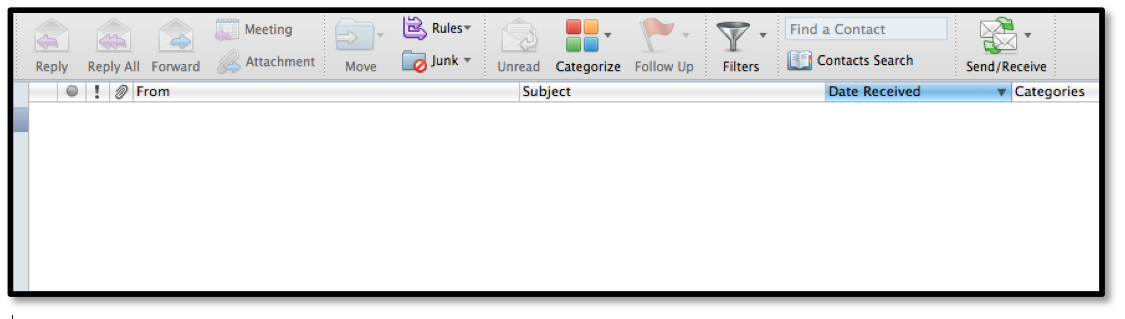
Below is a screenshot of something that I love to create several times each week: my empty inbox. An empty inbox is an indicator that we’re responding to our customers in a timely fashion. And it simply helps me feel more relaxed and organized. You know, I try not to be obsessive or unrealistic about keeping an empty inbox. But I do have a simple goal and some good habits to help me get there. Here's what I do...
My Simple Goal
I have a simple goal that helps me keep my email under control: to end each day with less than ten emails in my inbox. Ideally, I'd end each day with an empty inbox but that's not realistic. Most days I'm successful at hitting this goal. But I've found that the 80/20 rule applies here. I hit my goal about 80% of the time. And that still feels great. Further, I don't worry too much about my email on days off. I don't apply my goal to those days. I realize that my situation is different than yours. I only receive about 350 emails each week. Some of you receive much more than that. And, since I run my own business I may have more control of my time than you. Despite these differences, I maintain that you'll still benefit from setting a specific email goal that works for you.Create Simple Habits to Support Your Goal
With a goal in place, you'll need some simple habits to help you reach your goal. Here are four of mine:I create accountability by sharing my goal with others.
Peer pressure works wonders. Heck, in this blog post I'm sharing my goal with the world. Talk about accountability!I process my email throughout the day.
Frankly, I'm not sure if this is a good strategy or not. I've heard several email experts say that you should check your email once or twice a day. But that doesn't seem to work for me. If I check my email infrequently then my inbox builds up and it slows me down from responding to my clients in a timely fashion.I use the phone
Email is great for quick correspondence. But for more in-depth issues, email can be less efficient than a conversation. So, it's not uncommon for me to receive an email and, instead of responding, I simply pick up the phone and call the person. That's often faster and more effective.I keep my email subscriptions to a minimum
If I don't get value from an email subscription then I cancel it. So, those are four of my habits. I hope they give you some ideas about what can work best for you.
By the way, I'm definitely not an expert at this email thing. I'm right there with you, learning along the way. I've just been fortunate to arrive at a system that works well for me. If you'd like to learn from the experts then consider these books:
Inbox Freedom: The Zen Master's Guide to Tackling Your Email and Work by Mike Ghaffary and Charles Hudson.
Declutter Your Inbox: Inbox Detox in 6 Easy Steps - Increase Productivity and Finally Get to Inbox Zero by Dewan Bayney.
Good luck!