
How Mission Met Manages Performance
We’ve found value in fostering an environment that supports further growth and development with all of our team members and we know that our performance management processes have contributed many benefits to our organization. We’re sharing some examples of those processes.
“Leaders become great not because of their power, but because of their ability to empower others.” — John Maxwell
What I’m about to say should come as no surprise to nonprofit executive directors: It’s important to support your team in their work. While we’ll soon post about the basics of performance management, in this article we explain how we approach it at Mission Met.
Fostering a culture that supports further growth and development with all of our team members is critical. And, our performance management processes are central to that effort.
The combination of assisting our team with their current job responsibilities while also encouraging their personal and professional growth results in the following benefits:
Improves work engagement
Contributes to a positive culture of support, learning, and development
Helps retain team members
Performance management is a topic on which many executive directors are seeking information. Based on my own conversations with customers and recent articles for the nonprofit sector (such as the Great Resignation and employee retention), how to manage performance and keep talented team members is top of mind for leaders of nonprofits.
I’d like to share some of our company’s practices and resources in hopes that this information will be valuable for your nonprofit’s performance management processes.

Twice-Weekly Team Standup
Since our team works remotely, we’ve found it’s important to have a cadence of regular check-ins. Twice a week, our entire team gets together to each share about what they are doing. In particular they answer these three questions:
What has been your focus recently?
What are you plan to work in the next day or two?
Are you blocked on a project or task?
Each team member takes 2 to 3 minutes at most to review their work.
This meeting tends to be task-focused and less about strategy. We keep it to 30 minutes and remind each other that it is not a meeting to sift through the comprehensive list of what everyone has on their plate. It’s only to discuss the priorities of the week and to remove any barriers that might be in the way of that work. This helps all team members prioritize their work alongside others and have a sense of what the team is accomplishing.

Staff ONE-ON-ONEs
We try to keep our meeting frequency across our team to a minimum. The common meme of “this meeting could have been an email” is regularly shared between employees. However, 1:1 meetings with staff and their supervisors is a staple with our team. They are prioritized and rarely canceled.
We’ve found that the weekly 1:1 meeting is an important, dedicated time (typically 30 minutes) for open-ended conversations. This meeting is where strong relationships are formed via coaching and mentorship (and the occasional venting).
Suggestions for this type of meeting include the following:
Follow a loose structure, more so than a set agenda
Managers typically start by asking what the employee would like to discuss
Create a shared document (could be a doc or in a performance management tool) where you both can enter any topics to be discussed. This is helpful so topics aren’t forgotten.
We’ve written on tips for better employee engagement, and the 1:1 meeting exemplifies many of the tips from that article such as keeping communication lines open, providing regular feedback and support, reinforcing the organization’s values, and celebrating success.
If you need help developing more effective tools for employee engagement at your nonprofit, we recommend reviewing the work of Manager Tools and in particular their work on 1:1s.
Strategy
If your nonprofit has followed our strategic planning method, the CAPE Cycle, you should be a pro at developing and executing your strategy with goals that support focus areas and priorities.
Encouraging engagement from all team members during the development and execution phases of your strategic plan will make your goals more achievable because everyone is a stakeholder and wants to see the success of the plan.
The team at Mission Met creates a strategic plan for our company and we follow our same guidance for meetings about strategy that we provide to our customers. We recommend a monthly champions meeting, a quarterly team meeting, and a strategy development meeting (that includes separate times for leadership and the entire team to provide insights.)
Monthly Meeting
Who attends? The co-champions of the plan meet monthly to review the team’s performance.
What are the key objectives? Champions should get a snapshot of goal completion timelines and review the team’s performance. Champions share their observations and they collectively develop a list of what needs to be shared with the team prior to the next quarterly meeting (such as important dates, reminders, celebrations of success, and agenda for the next meeting.)
Quarterly Meeting
Who attends? The entire team meets quarterly to review the plan.
What are the key objectives? Each team member walks away from this meeting with a clear understanding of the goals they will work toward in the next quarter and any questions regarding the plan have been answered.
Annual Strategy Development
This meeting is similar to an annual retreat for nonprofits.
Who attends? The first session is for leadership. A second session is for the entire team.
What are the key objectives? The leadership reviews feedback from their team and they set strategic priorities for the next year. The entire team helps to develop the goals for each priority.
Software
Executive directors often ask us for suggestions about how to use Mission Met Center as a performance management tool. For that reason, we developed a way for nonprofits to host individual plans for all of their team members (in addition to their overall strategic plan).
Best practices for hosting individual plans include the following:
Managers are administrators on their team members' plans.
Work together to populate the focus areas, goals, and action items. (Some of these items for an individual might overlap with the organization’s strategic plan but in many cases, separate focus areas and goals are documented.)
The team member regularly tracks their updates/progress and managers can review in times of check-ins or evaluations.
Don’t be afraid to put personal goals (health, personal coaching and development, travel, etc.) as each team member has their own life pursuits.
This is a great way for managers to encourage both professional and personal growth as we’ve seen individual plans include personal goals such as pursuing further education, work/life balance, and improving upon certain skills that are helpful in both the workplace and life (time management, interpersonal communication, etc.).
Employee Handbook
The employee handbook is a valuable resource for all types of organizations and employee level status and title (new hires, long-term employee, managers, part time, volunteer, interns, etc.). It documents all policies and procedures. It’s also a great communication tool for emphasizing your organization’s mission, vision, values, and practices.
We created our employee handbook with the help of a template from Workable.
We tailored the employee handbook template to fit our needs and continue to develop it as our team grows and changes. It is a living, breathing document that needs to be regularly visited. Additionally, we include our stakeholders, our team members, to contribute their ideas to the employee handbook. You want their input when you’re creating any policy or procedure that involves them. This helps enforce shared ownership of the culture and improvement of our company.
INTERNS: DAILY JOURNALING
It’s vital that you don’t forget about your interns! After all, they are working with your nonprofit to gain experience and part of that experience is learning about what’s expected of them, how they will be evaluated, and opportunities for future growth.
Just as you should be clarifying the workplace policies that apply to your interns, you should also consider how to manage their performance. We’ve implemented a daily journal project for all interns to document their work.
This journal activity allows them to reflect on the scope of their projects through daily updates.
Prompts we encourage in the journal for specific projects include the following:
What is working?
What is not working?
What is something they could do differently?
The journal affords an intern time to reflect on their projects weekly. It also allows the intern managers to review the entries prior to meetings so they are most prepared for the conversations. The journal also provides us with documentation after an intern completes their work with us in the event we need to revisit any of the work.
Conclusion
Your performance management policies and procedures can contribute to a positive culture at your nonprofit. We know our work has contributed greatly to ours. Similar to a strategic plan, begin by writing your workplace values and what you think it will take you to get there. Make those items your goals and work towards achieving them.
As outlined in this article, your performance management strategy can include a combination of meetings, documentation, processes, and online tools. Don’t forget to solicit feedback from your team along the way as this will continue to improve team relationships and show that you value their input.
elcyciB sdrawkcaB a gnidiR
Uh, what? Now, try reading the title of this article backwards, starting from the far right and reading to the left. It likely took you a few seconds to do that, going letter-by-letter to make the title out: "Riding a Backwards Bicycle".
You know, you've spent your whole life paving pathways in your brain to read from left-to-right. It's a well-ingrained habit that is difficult to change.
What about another ingrained habit, like riding a bike. What if a bike was set up "backwards" in some way? Could you ride it?
Take a few minutes to watch this entertaining video to learn more. You'll find the time well-spent and may even want to share it with your friends.
So what does this all of this have to do with strategic planning, leadership, management, and running a nonprofit? A ton. Essentially, building your organization's capacity is often about overwriting old habits with new ones. Just like learning to ride a different type of bike.
What are some of those old habits that you might like to change? Try these:
Writing strategic plans but not implementing them.
Waiting to the last minute to complete grants.
Doing more work in the evenings and weekends than you'd like.
Viewing funders as people that support you (versus people that you support too).
Providing the executive director with sporadic performance reviews.
Doing everything yourself and not delegating very effectively.
You may not view these as habits, but they are. They're individual and organizational habits. And, like the guy in the video, with some insights and a committed practice, you can change them.
Which brings me to an excellent resource for you if you'd like to learn more about changing habits: The Power of Habit: Why We Do What We Do in Life and In Business by Charles Duhigg. I read this book last year and have meaning to write about it ever since. It's fascinating. Duhigg provides a fantastic overview of how habits form and how you can change them. So, if you're serious about making changes in your life or organization, the concepts in this book are gold. The ideas will even help you ride a backwards bicycle if you'd like...

Charles Duhig - The Power of Habit
Why I'm Happy to be a Freak

LG Cosmos flip phone
(Note: I wrote this back in early 2016 (despite the 2019 date above). Well, in 2017 I ended up migrating to an iPhone. It just became super obvious that the dumbphone was holding me back from providing my team and customers with the support they deserved. The shift was one of necessity to serve better.)
In the high-tech San Francisco area where I live, I'm a freak. You see, I'm one of the few that choose to use a dumbphone instead of a smartphone. A picture of my humble little LG Cosmos flip phone is above. It's decidedly not very cool. It just makes phone calls, texts, and takes horrible 1.3-megapixel photos. And I couldn't be happier.
I've made that choice not because I'm fearful of technology. I've designed and built electric cars. I've produced websites, built awesome spreadsheets, and co-founded a strategic planning company that has built a strategic planning software platform. I'm comfortable with technology.
And, I don’t have anything against smartphones. A while back I tried out both the iPhone and a Droid for a few weeks. They were incredible in the millions of things they could do. But that's just it. I don't need my phone to do a million things. I just need it to make phone calls and send texts. (I use my laptop to send emails and conduct all of my other internet-based business.) So after a few weeks, I returned the amazing smartphones and went back to my dumb phone. I realized that, when compared to the iPhone/Droid, my flip phone helped me to:
Disconnect and keep my life a little simpler.
Maintain better control of my time.
Focus on those around me rather than get distracted by the cool apps on the phone.
Basically, the smartphones weren't the best fit for me. It turns out that I'm not alone in my perspective. Check out these articles that convey similar sentiments:
So, that's my phone story. I share it with you with the intention to help you think a little bit about your phone choices. Whatever type of phone you use, I hope it is meeting your needs. If you're like me, sometimes I get sucked into the cool gadgets before I realize what's going on. Perhaps this article will help you pause for a moment and consider your options. You know, I'll probably have to get a smartphone at some point. Or at least a smarter phone than the one I have now. But in the meantime, I'm happy being a freak.
Would You Like Zero Emails in Your Inbox?
Screen shot 2014-06-20 at 8.23.38 AM
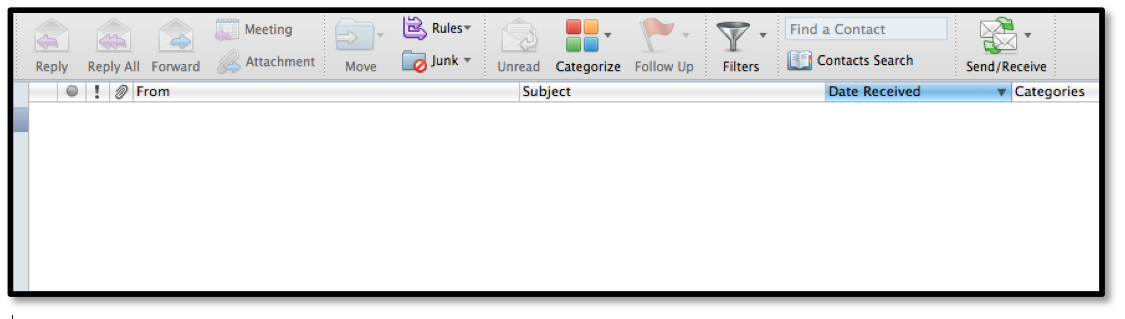
Below is a screenshot of something that I love to create several times each week: my empty inbox. An empty inbox is an indicator that we’re responding to our customers in a timely fashion. And it simply helps me feel more relaxed and organized. You know, I try not to be obsessive or unrealistic about keeping an empty inbox. But I do have a simple goal and some good habits to help me get there. Here's what I do...
My Simple Goal
I have a simple goal that helps me keep my email under control: to end each day with less than ten emails in my inbox. Ideally, I'd end each day with an empty inbox but that's not realistic. Most days I'm successful at hitting this goal. But I've found that the 80/20 rule applies here. I hit my goal about 80% of the time. And that still feels great. Further, I don't worry too much about my email on days off. I don't apply my goal to those days. I realize that my situation is different than yours. I only receive about 350 emails each week. Some of you receive much more than that. And, since I run my own business I may have more control of my time than you. Despite these differences, I maintain that you'll still benefit from setting a specific email goal that works for you.Create Simple Habits to Support Your Goal
With a goal in place, you'll need some simple habits to help you reach your goal. Here are four of mine:I create accountability by sharing my goal with others.
Peer pressure works wonders. Heck, in this blog post I'm sharing my goal with the world. Talk about accountability!I process my email throughout the day.
Frankly, I'm not sure if this is a good strategy or not. I've heard several email experts say that you should check your email once or twice a day. But that doesn't seem to work for me. If I check my email infrequently then my inbox builds up and it slows me down from responding to my clients in a timely fashion.I use the phone
Email is great for quick correspondence. But for more in-depth issues, email can be less efficient than a conversation. So, it's not uncommon for me to receive an email and, instead of responding, I simply pick up the phone and call the person. That's often faster and more effective.I keep my email subscriptions to a minimum
If I don't get value from an email subscription then I cancel it. So, those are four of my habits. I hope they give you some ideas about what can work best for you.
By the way, I'm definitely not an expert at this email thing. I'm right there with you, learning along the way. I've just been fortunate to arrive at a system that works well for me. If you'd like to learn from the experts then consider these books:
Inbox Freedom: The Zen Master's Guide to Tackling Your Email and Work by Mike Ghaffary and Charles Hudson.
Declutter Your Inbox: Inbox Detox in 6 Easy Steps - Increase Productivity and Finally Get to Inbox Zero by Dewan Bayney.
Good luck!
How Much Money Do You Make?
Guidestar Compensation Report
As a nonprofit leader you may face an ongoing question: what is fair compensation for the staff?You'd like to pay them at least what they'd get at a similar organization. But finding salary rates for other nonprofits can be difficult.That's where the Guidestar Nonprofit Compensation Report comes in.Established fourteen years ago, the report is a comprehensive overview of nonprofit salaries. Based on IRS data, the report provides salary information broken down by:
Top organizational positions (executive director, development director, programs director, HR director, IT director, etc.)
Organization size by revenue ($250k or less, $250K - $500K, etc.)
Organization type (education, environmental, civic, etc.)
Geographical area (state and metropolitan area)
Gender
You can view a sample report here. Here's the kicker. For most small nonprofits, the $374 starting price is steep. That said, if you could use some accurate salary guidance then the investment may be worth it.