

Core Values and Practices Are Booster Fuel for Your Business. Here's How to Establish the Right Ones.
As a nonprofit leader, are you looking for your team to increase efficiency and productivity, improve communication and make better decisions? Creating a positive culture by implementing values and practices may be the answer.
This article was originally written for entrepreneur.com.
As a long-time strategy consultant, I learned early on in my career that if I wanted my clients' businesses to succeed — financially and otherwise — then I had to first help them clarify and strengthen their business culture. This idea is backed by Peter Drucker, one of the most prominent management consultants of all time, when he said, "Culture eats strategy for breakfast."
Culture, however, is a pretty amorphous idea. It's sort of like love. You know what it feels like but it can be a hard thing to describe and/or know how to build. That's where your business' values and practices come in.
Values and practices clarify how your team thinks and acts and serve as the bedrock of your company culture. Capturing, communicating and living a succinct and well-defined set of values and practices is pure gold that directly leads to:
Increased efficiency
Better decision-making
Improved communication
Managed expectations
Stronger productivity
More effective hiring practices
Greater profitability
Here are some time-tested ideas about both creating values and practices and how to best implement them.
Values vs. practices
Values and practices are similar in that they both are meant to describe the ways that you and your team think and act. However, values are more general and lofty while practices describe practical and specific actions.
Below is a brief list of some values and practices that will help you differentiate between the two.
Values
Accountability
Collaboration
Inclusion
Make it happen
Keep it simple
Not bound by convention
Persistence
Teamwork
Practices
Clear out email once per week
Express gratitude and appreciation
Invest in your professional growth
Leave meetings with clear next steps
Practice financial transparency
Seek first to understand
Serve while selling
Set outcomes-based agendas
As you can see, some of the values are only one word and others are short phrases; either way works. Also, note that each of the practices begins with a verb to make them active.
Some key tips for establishing values and practices
There are a variety of ways to establish and implement your ideas, but the most important thing is to focus on values first. Once you've created a set of values then you can move on to identifying your practices. It can be a bit much to tackle both at the same time, but your values can help inform your practices.
Resist the temptation to list all of the values of your business. What you're seeking are four core values that are especially unique to your business. You're looking for non-negotiable qualities of your company and culture that differentiates you from others in your space.
You want to keep your list of practices to a manageable size. I recommend having 10 practices. Because practices are much more specific and tactical, having a larger list than your values is fine.
When eliciting potential values and practices, ask your team for advice. Ask them about a staff member who represents what is best about your business. What are their core qualities? What do they do well? Alternatively, ask them to think of some former staff members that weren't a good match for your company. What were their qualities and/or work habits that made them a mismatch for your culture?
Implementation and revision
After creating your values and practices, don't let them collect dust! Determine how you can apply them to daily operations so they stay top-of-mind and have a better chance at guiding the creation of your business culture. Here are some examples:
Share your values internally and externally. Being upfront about your values builds trustworthiness and long-term relationships with your team and customers. Post your values and practices into any company-wide publication such as your strategic plan, employee manual, business cards, posters for your office, meeting agendas, your website and even marketing materials.
Clearly communicate your values and practices during onboarding and training processes.
Make sure your management team is also embodying these values and leading by example.
Use your values as a filter in your hiring processes. Asking interview questions that relate to your values enables you to make more informed decisions when hiring. For example, if you have a value about teamwork, ask a candidate what role they usually play on a team or ask them to provide examples of a team failure or success they have experienced.
Celebrate your values. At my company, we set up a simple way for all employees to submit a video or text message of praise for anyone they see living out the values of our business. When we first started doing this, we required all team members to do this once a month with the hope that it would become ingrained in our culture. We then highlight these "shoutouts" during team meetings.
Get regular feedback from your team. We do this by sending a quarterly culture survey to our team. The survey asks them questions to determine if the values and practices are clear to them. It also asks them to rate which values and practices are most beneficial to the team and to their work. After collecting survey results, we meet as a team to discuss our values and practices.
As you implement your values and practices, you're going to learn about what works and what doesn't. As such, be prepared to revise them. At my company, we have a solid set of values and practices that we spent a fair amount of time creating. But as our business evolves and we bring on new team members, we revisit the values and practices and revise them as needed.

I Asked AI to Create a Plan for a Fake Organization — The Results Blew Me Away, But Not in the Way You Might Think
With all of the recent news about artificial intelligence (AI), it got me thinking about the potential impact of AI on strategic planning — my area of expertise. So I did a little experiment: I went to ChatGPT and asked it to craft a strategic plan for a fictitious organization. Check out what happened next in this article.
This article was originally written for entrepreneur.com.
With all of the recent news about artificial intelligence (AI), it got me thinking about the potential impact of AI on strategic planning — my area of expertise. So I did a little experiment: I went to ChatGPT and asked it to craft a strategic plan for a fictitious organization.
The plan that was created — in 15 seconds — was actually pretty good. I was blown away, but I also realized there are problems that will crop up in the process AI will just never be able to solve.
Since then, my team and I have been actively thinking of ways that we can leverage AI to help us make strategic planning even simpler and more effective for our clients. Below are some of what we consider to be the opportunities and challenges of AI in the realm of strategic planning.
Opportunities of AI in strategic planning
Efficiency: AI can automate routine tasks, handle large data sets swiftly, and provide instantaneous access to a broad knowledge base. I see this as being useful in requesting information and receiving answers quickly to questions you may have regarding your strategic plan, finding ways to succinctly phrase complex ideas or draft communications to stakeholders.
Data analysis: AI's superior data analysis capabilities can uncover trends, patterns and insights from large datasets which might be overlooked by human analysts. This can help when reviewing transcripts of interviews or focus groups to find common themes and truly unique ideas. But be careful — you have to understand how the answer is arrived at.
Idea generation: AI can use its extensive training data to generate a wide array of ideas and solutions, potentially sparking novel strategic insights. If you're struggling with a challenge in your strategy, you might be able to find creative solutions through AI. Prompt ChatGPT or any Large Language Model with your situation and see what comes out of it. The action steps it lays out could become part of your strategic plan.
Scenario planning: AI can suggest a range of possible future situations based on trends and patterns, helping organizations prepare for various potential scenarios. While none of us know the future, this opportunity can help you manage risk by reviewing various scenarios that may arise. You can share your situation or your entire plan and then ask "What possible situations or scenarios could arise that might cause challenges for us in completing our goals?" or "What are some assumptions that we might not realize?" in order to uncover potential risks.
However, alongside these exciting opportunities, it's equally crucial to understand the limitations and challenges posed by AI in strategic planning.
Challenges in AI-aided strategic planning
Contextual understanding: While AI can process and generate responses based on patterns, it currently lacks a deep understanding of the context that humans naturally possess. This can sometimes lead to responses that miss certain nuances. Every customer with whom I have worked in my 25+ years as a strategic planning consultant has had a challenge that is specific to their organization and the unique personalities in the organization. It has required me and the leaders of the team to get creative with developing a plan to overcome an obstacle in a way AI would be limited. When dealing with complex situations, nuance in understanding and action is critical.
Lack of buy-in: While using AI can make the creation of your plan more efficient, if you don't engage your team along the way then you lose out on one of the major benefits that strategic planning brings: buy-in and commitment. A phrase that I learned long ago is that "people support that which they create." If AI creates your plan, then your team won't have nearly the same level of ownership or passion for the plan as they would if they had tussled with it themselves. Further, that lack of buy-in will hurt your team's ability to execute the plan since they may feel that they're being told to do something rather than creating it themselves.
Ethical considerations: AI lacks an understanding of ethics and can't make moral judgments. As such, humans need to ensure ethical considerations are taken into account in the planning. AI often attempts to achieve "objectives" regardless of the implications of the approach. However, thankfully, most humans pause before taking any action and run it through a set of ethical, moral and social considerations before taking any action. You don't have to search far to find stories of AI making "ethically questionable" decisions. Be aware of this while you explore.
Data privacy: Using AI tools can potentially expose sensitive company information. It's crucial to use trusted and secure AI systems and always proof the content (ideally more than once and by multiple people) before disseminating it. Sharing sensitive information with AI tools can then "leak" into its training data and allow that sensitive information to be used or shared in unexpected ways. Be aware of the privacy policies and data governance procedures in place with any tool you use, especially an AI system.
In addition to these opportunities and challenges, there are many other considerations when looking at AI tools to augment strategists and leaders that need further exploration: costs of AI training and implementation, embedded bias in AI, regulatory compliance and perhaps most importantly, how people will react to incorporating AI into our work lives.
The key takeaway here is that while AI can offer significant enhancements to the strategic planning process, it should be seen as a tool to accompany human capabilities, not replace them. The unique value of human intuition, experience and ethical judgment remains paramount.
As we move into this new era of strategic planning, it's important that we navigate this space with both anticipation for the opportunities and respect for the challenges. Used wisely, AI tools can become powerful allies in our quest to make strategic planning more effective, simple and insightful.
I'm excited to see where all of this goes and potentially be at the forefront of figuring out how best to integrate AI into strategic planning.

Friday Fives: A Simple Best Practice for Executive Directors to Connect With Their Team
This article was written by Sara McKeown White, LCPC, the executive director of the Mental Health Coalition of Teton Valley. She and her team have been engaged in Mission Met’s strategic planning cohort program with other nonprofits in Idaho’s Teton Valley. It explains how a regular email process has helped build their relationships with each other and their strategic plan.
This article was written by Sara McKeown White, LCPC, the executive director of the Mental Health Coalition of Teton Valley. She and her team have been engaged in Mission Met’s strategic planning cohort program with other nonprofits in Idaho’s Teton Valley. It explains how a regular email process has helped build their relationships with each other and their strategic plan.
As a mental health organization, the Coalition takes relationships and culture seriously. Maybe too seriously sometimes. That’s why having a strategic planning tool like Causey (formerly Mission Met Center) that integrates metrics, timelines, and status reports has been so helpful for our growth.
However, we didn’t want to completely lose track of the relational component of moving our organization forward. After all, people are at the heart of those metrics. That’s why we updated our Friday Fives email to include a report about the “touchy-feely” side of strategic planning.
What is Friday Fives?
The Friday Fives email is something we started doing when I first became Executive Director a couple of years ago. I was looking for an easy way to build relationships, keep connected, and share information with board members without bombarding them. While I was mainly fueled by my obsessive desire to have healthy relationships with all of them, I also wanted to keep the organization at the top of their minds. That way they could better do their jobs of fundraising and outreach.
Now, it’s one of the easiest things on my To-Do List and has a pretty high return on investment. At first, I just emailed five bullet points summarizing “what had been happening this week at the Coalition” to all our board members every Friday. Over time I realized I was only sharing positive things, which meant my board was missing out on a critical component of healthy relating—knowing the hard stuff too. So one point is now reserved for something I’ve been struggling with that week.
How I Incorporate Our Strategic Plan into Friday Fives
For the first year or so, there wasn’t a rhyme or reason for what I shared. It was just a greatest-hits list. As we’ve refined our strategic plan, we’ve updated our Friday Fives email to track the three focus areas we have. This allows us to highlight the work we are doing, or not, in real-time. It also makes our strategic plan a living document we are all relating to every week.
Brene Brown, one of our organizational heroes, says, “Clear is kind.” The Friday Fives email is a clear way of communicating. It builds the relational power of your team by keeping board members connected to the organization through bite-sized stories. It boosts morale because each week they are seeing the good work they are part of, which makes them more likely to engage in and help spread the word about that work. And it gives you an opportunity to highlight staff when you let them write one of the points and copy them on the email. So healthy office culture grows too.
Your strategic plan doesn’t just have to move your mission forward in a sustainable way, it can move your relationships and culture too. Try it and let me know how it goes. You might just make one of our Friday Fives!

Improve Your Nonprofit’s Programming Focus Through Matrix Mapping
I often notice that a nonprofit’s success comes down to one discipline — a focus on doing one thing very, very well. A matrix map is a powerful tool for visualizing the connection between an organization's activities and its financial profitability. Learn more in this article about how this tool can help you focus.
This article was originally written for NonProfit Pro.
I often notice that a nonprofit’s success comes down to one discipline — a focus on doing one thing very, very well.
After all, there are plenty of businesses whose focus is a key element of their success. Henry Ford reportedly said, "We'll build you any type of car as long as it's a black Model T." And when McDonald’s first started out, they focused exclusively on serving only a burger, fries and a Coke. They didn't expand their menu until they got their core product completely dialed in.
This truth extends to nonprofits, where the level of focus on products, programs and services can make all the difference in the impact your organization can make.
One of the most successful nonprofits that I’ve worked with, Vida Verde Nature Education, delivered only one simple program for about the first 15 years of its existence — just one program! That focus allowed the organization to create extraordinary results for those whom they served while building the financial and muscle needed for organizational health.
The Basics of Matrix Mapping
I learned about matrix maps from the wonderful book by Steve Zimmerman and Jeanne Bell called "The Sustainability Mindset: Using the Matrix Map to Make Strategic Decisions." Bell is my colleague, and I think highly of her and her excellent work.
In summary, a matrix map is a powerful tool for visualizing the connection between an organization's activities and its financial profitability.
The benefits of a matrix map are clear. It helps you determine how you can refocus and make more informed decisions. With a matrix map, you can easily pinpoint areas for improvement, identify opportunities for growth and make informed financial decisions.
The basic steps involved in creating a matrix map are:
Identifying your core activities.
Determining the impact that those activities have on your mission.
Clarifying the profitability of those activities.
Mapping the results of your assessment.
Connection Between Matrix Mapping and Strategic Planning
So, what can you do with the results of your matrix map? I suggest using that valuable insight to strengthen your nonprofit's strategic plan.
Specifically, I’ve found the results of a matrix map to be very helpful in providing insights into nonprofit programs. Considering that programming is one of the most common focus areas of a strategic plan for nonprofits (while also being one of the common areas that loses focus over time), a matrix map is a worthy exercise for evaluating this common priority.
Nonprofits are often faced with the challenge of allocating resources to numerous programs, while also ensuring that their program goals coincide with the organization's overall mission. A matrix map will help you identify the impact of your programs and weigh that impact against the profits and costs.
As an example, many years ago I was working with the staff and board of the YWCA of Golden Gate Silicon Valley on its strategic plan. The core challenge the organization faced was if the numerous programs created over the years were mission-critical and/or bleeding its funds. Creating a matrix map during a half-day planning session helped the organization decide to cut about 25% of its programs. The nonprofit captured and executed that strategy in its strategic plan.
By prioritizing actions based on their impact and profitability, you can ensure that your nonprofit is focusing on the most essential and effective actions to achieve your goals.
Utilizing a matrix map can help you focus on success. Using the information you obtain from the map will support your nonprofit's strategic plan by allowing you to identify key strategies, define the impact and feasibility of different activities, create a visual representation of the relationship between impact and profitability, and prioritize actions.
By using a matrix map as a strategic planning tool, your nonprofit can ensure that it is focused on the most essential and feasible actions to achieve its mission. Consider using this powerful tool to focus on success and enhance your nonprofit's effectiveness.

How to Find Your Brand and Voice as a Nonprofit
Every nonprofit has its own mission and goals, but in order to truly make a difference and reach your audience, you need a strong brand and a clear voice. But how do you go about finding your brand and voice as a nonprofit? In this post, we’ll explore some key steps you can take to discover and define what makes your organization unique, why it’s important to know your audience, and more about your tone and branding.
Every nonprofit has its own mission and goals, but in order to truly make a difference and reach your audience, you need a strong brand and a clear voice. Your brand is what sets you apart from other organizations and helps people recognize the work you do in your community. Your voice is how you communicate your message and connect with your stakeholders who include the beneficiaries of your services and programs, the community impacted by your work, and donors.
But how do you go about finding your brand and voice as a nonprofit? In this post, we’ll explore some key steps you can take to discover and define what makes your organization unique, why it’s important to know your audience, and more about your tone and branding.
Define Your Mission and Vision
Before you can start building a brand and voice, you need to know what your organization is all about. Take some time to clearly define your mission and vision. This will help you understand what kind of messaging will resonate with your audience and what kind of image you want to portray.
Based on years of learning from organizations, we’ve defined mission and vision statements as the following:
Mission Statement: One succinct and somewhat timeless sentence that states what your organization does and for whom
Vision Statement: One succinct, inspirational, and somewhat timeless sentence that describes what the world will look like when your organization succeeds at its mission
Importantly, there is a cause-and-effect relationship between the mission and vision. You want to be able to say that “if we succeed at our mission, then our vision is more likely to happen.”
Given this interrelationship, you can’t write a mission and vision statement in isolation from each other. They are two parts of a whole.
Engaging your team members in drafting and reviewing your mission and vision statements is an excellent way to keep them involved with the process. They serve as auditors for the organization.
Action to take now: Think about your mission and vision statement and what words and phrases best capture the essence of your work. Engage your team at your next staff meeting by asking, “What does our organization do? Who does our organization serve? And what will our community/world look like when our organization succeeds?”
Know Your Audience
To communicate effectively, you need to understand who you’re talking to. For nonprofits, you’ll have two audiences– the people you serve and those that fund them (your supporters/donors).
What motivates them? What kind of messaging will resonate with them? Getting to know your audience(s) will help you tailor your brand and voice to their needs and interests.
One tool that we have used to help focus on our main audience is by developing audience personas. Establishing audience personas can help you visualize who your supporters are, what their demographics may be, and what communication style will resonate with them. By narrowing your focus to specific supporters, you can create targeted messaging that speaks directly to their needs. This helps build a relationship with your supporters and fosters greater engagement.
Creating an audience persona doesn't have to be a daunting task, start by pinpointing the unique characteristics of your ideal supporter and build from there. The more detailed and specific your persona, the more effective your messaging will be at resonating with them. Collect as much information as possible for the persona including demographics, behavior patterns, interests, motivations, and pain points. It's also essential to consider your nonprofit's mission and how it relates to your audience's values and concerns.
Action to take now: Consider creating audience personas to help you picture your ideal supporters and constituents and craft messages that speak directly to their needs.
Identify Your Unique Value Proposition
What sets your organization apart from others in your field? What are your strengths? What are you doing that no one else is? These are questions to ask yourself to determine your organization’s unique value proposition, and it’s a key part of your brand. Being able to succinctly tell your nonprofit’s story including your mission, vision, and values, who you serve, and what makes you unique will help people remember you and will make you stand out from the crowd.
Action to take now: Identify your strengths and what makes you different and make sure that comes across in your messaging.
Choose Your Tone of Voice
Once you know what you want to say, you need to figure out how you want to say it. Your tone of voice is the way you convey your message – it’s the emotional and expressive aspect of your brand. Choosing the right tone is important – it will depend on your mission, audience, and unique selling proposition. At the heart of your mission, do you want to be inspiring, authoritative, friendly, or something else?
Action to take now: Think about what kind of voice will best communicate your mission and values and begin using that tone in all of your communications.
Visual Brand
A visual brand is not just about having a fancy logo or a catchy tagline. It's about creating an experience for your target audience. Everything from the typography and colors to the images and layout of your website or marketing materials is an opportunity to communicate your brand message. People remember visuals more easily than words, which is why having a strong and memorable visual brand is crucial. Your brand's visual identity is one of the first things that people see and may play a role in someone remembering what impact your nonprofit makes in your community. So, it's important to invest time and resources in creating a cohesive visual brand that accurately represents your nonprofit.
Action to take now: Design a logo and choose a color scheme that represents your nonprofit's values and mission. Don't underestimate the power of fonts and typography; they can also communicate a lot about your organization's personality and style. Begin using these items in all of your communications.
Be Consistent
Once you’ve figured out your brand and voice, it’s important to be consistent. Whether it’s in your email newsletters, social media posts, or annual report, your messaging should be consistent across all channels. This will help reinforce your brand and make it easier for people to recognize and remember you.
You control your nonprofit’s story and the way you share it. Here are some examples of the way nonprofits inspire others by the stories they tell and how they tell them.
Integrate Branding Into Your Strategic Plan
If all of this seems like a lot to consider, we strongly suggest that you include this work as a component of your strategic plan. It’s not unusual for our clients to include marketing or branding as a “focus area” of their plan, complete with a few key goals. This is what this could look like:
Focus Area: Branding
Three-year Vision: Within three years we will have established a clear brand with stories and marketing collateral to back it up.
One-year Goals
Task Force: Create a small branding task force comprised of two staff members and two board members.
Brand Qualities: Identify the top three qualities of our nonprofit’s brand.
Brand Standards: Establish a set of brand standards and train our staff and board on their use.
Conclusion
Finding your brand and voice as a nonprofit requires some soul-searching and strategy, but it’s worth it in the end. A strong brand and clear voice will cut through the noise and make people take notice of the great work you’re doing. By defining your mission and values, knowing your audience, identifying your unique selling proposition, choosing your tone of voice, and being consistent, you can create a brand and voice that truly represents your organization and helps you make an impact.

What Vince Lombardi Can Teach You About the Importance of Having a Clear Vision
Vince Lombardi and John Madden emphasize a similar core strategy for coaching as we do with our strategic planning customers: Be clear on your end in mind – your vision.
This article originally appeared on entrepreneur.com.
I've always been a passionate sports fan and love reading books about my sports heroes. As such, I recently finished John Madden's Hey, Wait a Minute, an old book where he shares his always-colorful experiences as the coach of the Oakland Raiders and as a TV and radio commentator.
In one insightful passage, he recounts his lone conversation with one of his heroes, Vince Lombardi, the legendary coach of the Green Bay Packers:
“The more we talked, the more I knew I had to ask him a question that had always intrigued me.”
”What is there,” I said, “that separates a good coach from a bad coach?”
”Knowing what the end result looks like,” Lombardi said. “The best coaches know what the end result looks like, whether it’s an offensive play, a defensive coverage, or just some area of the organization. If you don’t know what the end result is supposed to look like, you can’t get there…”
”After that, whenever I put something new in the Raider playbook, I always tried to picture what the end result should look like. And then I worked to create that end result.”
When I read that passage I nodded my head and thought, That's a core strategic planning principle that we teach our clients: Be clear on your end in mind – your vision.
I'm sure that if Lombardi was a strategic planner, he'd emphasize the power of being clear on your vision. Once you are, your goals fall into place.
Types of visions
There are two types of visions that we talk about in strategic planning.
The first is your vision statement — the big-picture idea of what your world, community, or audience will look like when you succeed at your mission.
The second is your organizational vision — what your organization will look like in the future. Three years into the future is typical for your organizational vision, but feel free to use a different timeframe that may better suit your needs.
I recommend keeping your timeframe within five years. There are several reasons why you should avoid going beyond five years. For one, the pace of change in today's world is rapid and it's hard to predict what the future will hold. Additionally, setting a shorter timeline keeps your team focused and accountable, encourages flexibility and agility, and allows for more frequent reassessment and adjustment of your strategies.
Crafting your vision statement
We've come up with what we believe is the simplest and most effective approach to vision statements.
For your vision statement, as briefly and specifically as possible, describe what the "world" will look like when you succeed at your mission. Keep the following recommendations in mind:
Vision statements should be one simple sentence each. This makes it easier to remember and helps you focus on essentials. Additionally, it will serve as a clear filter for making organizational decisions.
Your vision statement should be somewhat timeless. You don't want to have to change it every year or two.
Your vision should provide clarity and inspiration.
Your organizational vision assessment
To create your organizational vision, you first need to decide on a few focus areas. A few common focus areas on which business leaders focus their strategic attention are programs/services, staffing, finances, operations, and marketing.
I'd also recommend including strategic planning as a focus area. This will give it the level of significance it requires to become a part of your business process.
Once you set your focus areas, as specifically as possible, describe what you hope your organization will look like in three years for each of the areas. Here are some ideas on what those focus areas can and should include:
Programs or services: Should include your goals for your main product.
Staffing: Should consider your staffing structure and composition.
Finances: Can include issues about income, revenue, and expenses.
Operations: Can include financial management, human resource policies, risk management, facility maintenance, and office management.
Marketing: Can include issues of branding strategy, customer/stakeholder identification, digital communications, and events.
Together, these descriptions will comprise your organizational vision.
After you have the focus area visions set, ask yourself what needs to happen to make your vision in each of the areas become a reality. These actions, or any obstacles you see in the way of meeting a focus area vision, will become your goals over the next three or so years.
That's it. That exercise can be the start of your strategic plan. It really is as simple as that.
Of course, there are other models and assessments to help you recognize risks, opportunities, strengths, and weaknesses, but this is a pragmatic first step to creating your plan.
Your vision statement will largely stay unchanged. Your organizational vision exercise should be repeated on an annual basis. This assessment will help you to continue a strategic cycle of identifying focus areas and setting goals.
Take Lombardi's advice of always keeping your end result in mind and you are on your way to becoming a successful strategic planner.
Mission Met Center's Latest Features Announcement
Here is information about Mission Met Center’s latest feature updates.
Here is all the news on our latest features and updates to Mission Met Center.
Launch your organization 🚀
Meeting your needs when building and executing your plan
We recognize your organization has different needs from the application as you “build the plan” vs. “execute the plan” For this reason, we’ve developed a way to set the status of your organization to either “building” or “launched.”
Setting your plan to “building” will indicate to team members that the plan’s content is not ready for actions to be taken. Additionally, the automated messages that MMC sends to team members, such as the look-ahead and monthly progress emails, will be paused.
Once your organization is set to “launched” status, it indicates the plan is ready for action! If they are signed up, automated emails will be sent to team members.
Learn how to set your organization's status
Side note related to automated emails
We know you get a lot of emails. To help cut down on inbox clutter, we’ve made some changes to our automated messages. If you don’t have any items on the plan assigned to you, you will no longer receive a weekly look-ahead email.
Additionally, we’ve made the language more clear in the look-ahead email to indicate if items are due soon or if items on your plan are due at a later time. This will help you manage priorities while still letting you know important parts of your plan that are coming up.
Learn about automated emails and how to subscribe
Lock your plan 🔒
In plan settings, you can now “lock” a plan, which means a plan cannot be edited by anyone, including administrators. We recommend using this feature for all past plans. This will help stop the possibility of someone erroneously working on the wrong plan, regardless of if it is active or inactive.
Learn how to lock and unlock a plan
Ways to Share Your Plan
Presentation View Print Option 🎦
We’re thrilled with how many of you use Presentation View to present your plan to your board or other key stakeholders. We’ve enhanced this feature with a print-friendly version.
Learn more about Presentation View
Reports
You can also generate PDFs of all reports. Feel free to download and use for your own purposes or for sharing key information with others.
Clone
Focus areas can be cloned 🐑
You’ve been able to clone goals and now you can do the same with focus areas.
Stay tuned for additional exciting announcements in the upcoming months. Hint: 🏷️

Silicon Valley Bank and Your Nonprofit (worry but don’t panic)
The sudden collapse of Silicon Valley Bank serves as a reminder to all nonprofits: bad things can happen when you keep all your eggs in one basket.
This article was written by Sean Hale of Sean Hale Consulting.
The sudden collapse of Silicon Valley Bank serves as a reminder to all nonprofits: bad things can happen when you keep all your eggs in one basket.
In the course of 24 hours last week, that bank went from looking fairly healthy to becoming essentially worthless as it became unable to give its depositors back their money.
This was bad and could have been worse
Many depositors couldn’t get their money out of their accounts on Thursday or Friday of last week. Thanks to government intervention over the weekend, it looks like depositors can again access at least some of their funds as of Monday.
FDIC Insurance covers bank deposits of up to $250,000. That means that if a bank collapses, the federal government will step in and make the depositor whole again. At least up to $250,000.
But what happens if a depositor had more than that at the bank? Typically they could lose some or all of those funds, and at a minimum they may experience serious delays in being able to recover those funds.
In this particular instance, the government took the unusual step of actually covering the full deposit. This, however, leaves FDIC funds significantly depleted (making the next bailout difficult and a full bailout less likely).
This undoubtedly made for a difficult weekend for all SVB depositors, especially those organizations that needed to process payroll last week (or any other time-sensitive transactions).
This could happen to your nonprofit
It remains too early to know whether the SVP collapse was just a freak accident or the beginning of a more widespread problem in our economy.
Regardless, let this serve as a wakeup call to all of our nonprofits, especially those that have all their eggs in one basket.
Ask yourself:
What would happen if you suddenly couldn’t access your main bank?
What if that happened the day you have to process payroll?
Do you have more than $250,000 in any one bank?
Do you have enough funds in a different bank that you could cover at least month’s expenses if your main bank suddenly collapsed?
Count yourself lucky if your answer to the above questions is, “No problem! We have that covered!”
If you have a different answer, then you should do some follow up.
What can you do?
That depends on your role and how authority and responsibility get distributed at your organization.
Your next steps might look like:
Engaging your CFO or Fractional CFO to assess your particular situation
Asking your current bank(s) whether they participate in CDARS or an Insured Cash Sweep (these can protect assets above $250,000 in a single bank)
Distributing cash more evenly across current banks
Requesting that the board authorize the opening of a new bank account or two so you can diversify risk
Developing internal policies to guide your accounting staff and protect your organization going forward
Move deliberately and without rushing
Having all your eggs in one basket represents a risky proposition for any nonprofit at any time, not just today.
But if you rush to “just do something” rather than moving calmly and deliberately, you run the risk of breaking a few eggs that way as well. Rushing only makes sense if you believe the economy or the general bank situation appears poised to get worse.
You will serve your organization, staff, and mission well by making steady steps to get your eggs in diverse baskets and otherwise mitigate risks.
Pro Tip: You don’t need a dozen baskets
Be careful about the number of baskets you put your eggs into. Each one requires care and maintenance, and that means time and money.
On a similar note, we sometime see nonprofits create a new bank account for each restricted fund or grant it receives. Not only is this not necessary (unless the grantor specifically requires it), managing your money this way can quickly become cumbersome. Good bookkeeping and a good chart of accounts will allow you to appropriately track and report on restricted funds with much more ease.

4 Tips for Stress-free Strategic Planning for Your Nonprofit
Here are four practical tips that will make your nonprofit’s strategic planning less stressful while also strengthening your leadership, exciting your board, and building your organization’s capacity.
As a nonprofit leader, you have a lot to manage. Your job is a delicate balancing act between serving your constituents, managing the board, leading your team, organizing events, catching up on email, and so on. It can be stressful.
The day-to-day work often takes precedence to significant projects, such as strategic planning. Additionally, you’ve likely experienced some common complaints from past strategic planning processes – it takes too long, costs too much, and leads to overly complex plans that don’t deliver on their intended results.
For all of these reasons, strategic planning often drops down on the priority list for nonprofits, but it doesn’t have to be this way!
Below are four practical tips that will make your planning less stressful while also strengthening your leadership, exciting your board, and building your organization’s capacity.
Approach Strategic Planning as a Process, Not an Event
There’s no such thing as the perfect plan.
Repeat that to yourself again: There’s no such thing as the perfect plan.
And yet many executive directors and their boards spend way too much time and effort trying to create perfection. Talk about a waste of time, energy, and effort.
Instead, approach strategic planning as an ongoing dynamic process of creating, revising, and measuring your plan. With that mindset, you’ll be able to refine your plan over time while building your team’s muscle of executing it.
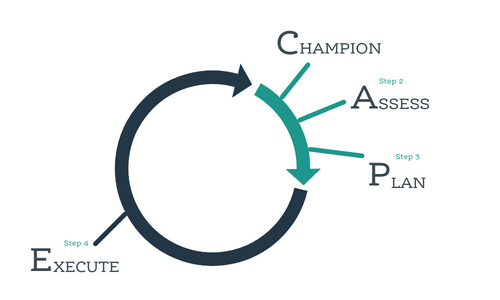
The process we use is a four-step method called the CAPE Cycle. CAPE is an acronym that means:
Champion the process.
Assess your organization and the environment in which you operate.
Plan your future by creating a simple, two-part strategic plan.
Execute your plan.
Engage Your Team
There’s a saying that we use with our clients: “People support that which they help create.” With that in mind, there are many ways to include your entire team in the strategic planning process, both in its creation and execution.
First, you’ll learn more about the organization by engaging your entire team during an assessment, a recommended phase of strategic planning that allows all team members and key stakeholders to provide input.
I also recommend you have one, but ideally two, co-champions for your plan. Their job is to simply ensure that your organization’s strategic planning process is executed and integrated into regular operations.
During the creation of the plan, provide the team with the main focus areas (e.g., Fund Development, Staffing, Operations, Programs, etc.) you see as the categories in which most of your strategic priorities encompass. Then invite team members to draft goals for themselves and for others within the focus area that applies to their work. Discuss the draft goals as a team to identify priorities, which allows everyone to be on the same page about strategic priorities, visions, and workloads.
At a minimum, the plan’s champions should meet monthly to review the overall plan and process. I recommend the entire team get together quarterly for a strategic planning meeting which reviews the plan and measures progress. These meetings are essential; a best practice is to calendar all of them out at the beginning of the year.
Don’t forget to update the team on milestones or changes to the plan.
Additionally, celebrate the successes! This is tremendously important work and taking the time to pause, reflect, and celebrate how far your team and nonprofit has come will improve engagement.
Leverage Software
You likely use multiple software programs that help you improve communication, make processes more efficient, and increase your effectiveness. Using strategic planning software can do the same by decreasing the stress of having to document and track your plan.
One of the best ways to ensure strategic planning success is to regularly measure your results. Planning software makes it easier to build your team’s measurement muscle and reduces reluctance within your team. Sync your plan with your calendar to ensure that you’re meeting deadlines and measuring results.
Planning software can also boost communication within your team and encourage accountability by sending automated reminders to review and measure the plan and any upcoming due dates. Reporting features make it easy to share your plan and any updates with key stakeholders, board members, and funders.
Similar to our approach to strategic planning, software platforms don’t have to be stressful. The software you choose should be simple to implement and use.
Get a Facilitator or Consultant to Help
Nonprofits typically have board members with many passionate, yet disparate voices. If the thought of leading this group through a strategic planning process is daunting, then a facilitator or consultant can significantly decrease your stress.
A good facilitator or consultant will help you make better decisions faster, teach you some best practices for crafting your strategic planning process and keep everything (and everyone) well-organized and on track.
No two strategic planning processes are the same, and no strategic planning process is perfect. Continue to strengthen your planning process and don’t be afraid to reach out to get some expert help.
These are just a few tips that may help you and your organization create a less stressful strategic planning process. In the process, you’ll be a more effective leader, your board will be happy, and your nonprofit will be able to work more effectively.

Stop Reacting and Start Strategic Planning
Transforming your nonprofit from a reactive to a proactive operation will involve changing mindsets, systems, and people. This article will provide you with a framework that will help you understand the different approaches to change and also highlight how strategic planning will help your nonprofit prioritize core actions that will tackle complex matters in ways that are sustainable.
Nonprofits are known for making the most out of limited resources and budgets. Due to the “do more with less” mentality, many nonprofit team members are juggling a variety of projects. This is tricky business as it often leads to urgency superseding importance.
The result? Time and capacity are limited and minor problems are ignored while major ones continue unresolved.
Strategic planning can offer a tremendous opportunity to nonprofits, allowing you to develop your capacity and move beyond reacting to situations as they arise. As a nonprofit leader, you’re likely looking into strategic planning to help transform your nonprofit from this reactive mentality to one of prioritizing core actions that will tackle complex matters in ways that are sustainable.
Transforming your nonprofit will involve changing mindsets, systems, and people. A framework will first help you understand the different approaches to change and provide a tool with which you can identify which approach is your current reality and which one is your desired reality.
This article will provide you with that framework and also highlight how strategic planning will help move your nonprofit from a reactive to a proactive operation.
Framework
The Four Approaches to the Future offers a unique perspective that can be leveraged for your organization’s transformation. It's more than just a concept - this is an invaluable tool you can use when making decisions and forming your mindset, allowing you to look ahead in order to redefine how you approach your vision for the future.
Reactive Approach
Rather than planning for the future, the reactive approach is more of a survival tactic; this means responding to what's happening in real-time with instinctual actions driven by each distinct situation.
Responsive Approach
Taking a responsive approach to the future means pausing and exploring all potential solutions before making any moves. This strategy is driven by problem-solving, allowing us to be prepared for what lies ahead.
Proactive Approach
Anticipating the future through proactive means can provide a wealth of opportunities. By recognizing upcoming trends and predicting their outcomes, we can identify potential advantages on our horizon.
Inventive Approach
By imagining the possibilities for our future, we can create a vision of what is achievable and use it to plan effectively. Team innovation lies at the heart of this endeavor. By setting goals and charting clear paths forward through imaginative collaborations, your team can work together to ensure success.
If you are currently in a reactive or responsive approach, you’re likely exhausted and wondering how to get out ahead of challenges and grow your nonprofit. Strategic planning is a process that can help move your organization into the proactive and inventive approach.
Be Proactive and Inventive Through Strategic Planning
By putting a plan in place with specific objectives and action steps that are organized into achievable goals, an organization is enabled to meaningfully pursue its mission.
Strategic planning is a valuable tool for nonprofits looking to establish a more secure footing and plan for their future needs. By examining how your organization operates and the resources needed to support its mission, you can set realistic goals and manage your organization more effectively.
For example, a plan with stated focus areas and goals will help you make decisions when another goal or focus arises. You’ll be able to differentiate the urgent from the important. Additionally, regular goal progress updates and measurements on key metrics for your plan will also provide you with data that will help you determine if resources are properly allocated.
One of the key outcomes of strategic planning is increased capacity. Through an audit of current operations and an assessment of what is needed moving forward, organizations can begin to develop stability, build positive relationships with their community and funders, expand operational capability, and make progress on program objectives.
Once you have a plan and process in place, you’ll find you can be more proactive in your approach to focus areas and goals. If you were previously at a work deficit on some projects, you’ll “catch up” and have the capacity to get ahead or even invent new solutions to your goals.
Conclusion
You have likely felt at one time or another that there are more problems than you have the time and resources to handle adequately. Instead of wasting energy struggling with smaller, often redundant concerns, use strategic planning as a way to focus on what is truly manageable and effective long term. In adopting a strategic planning process, you’ll be able to lead your organization away from reacting to small fires and approach being proactive in response to focus areas and goals.
We recommend reviewing the framework outlined above and document what percentage of your working time is currently spent in each of the four approaches. Then consider where you want to be by documenting what your ideal percentage of time spent in each approach would be.
After documenting your current and ideal status, consider how you get there. What steps can you take now to move your organization to that ideal percentage?